
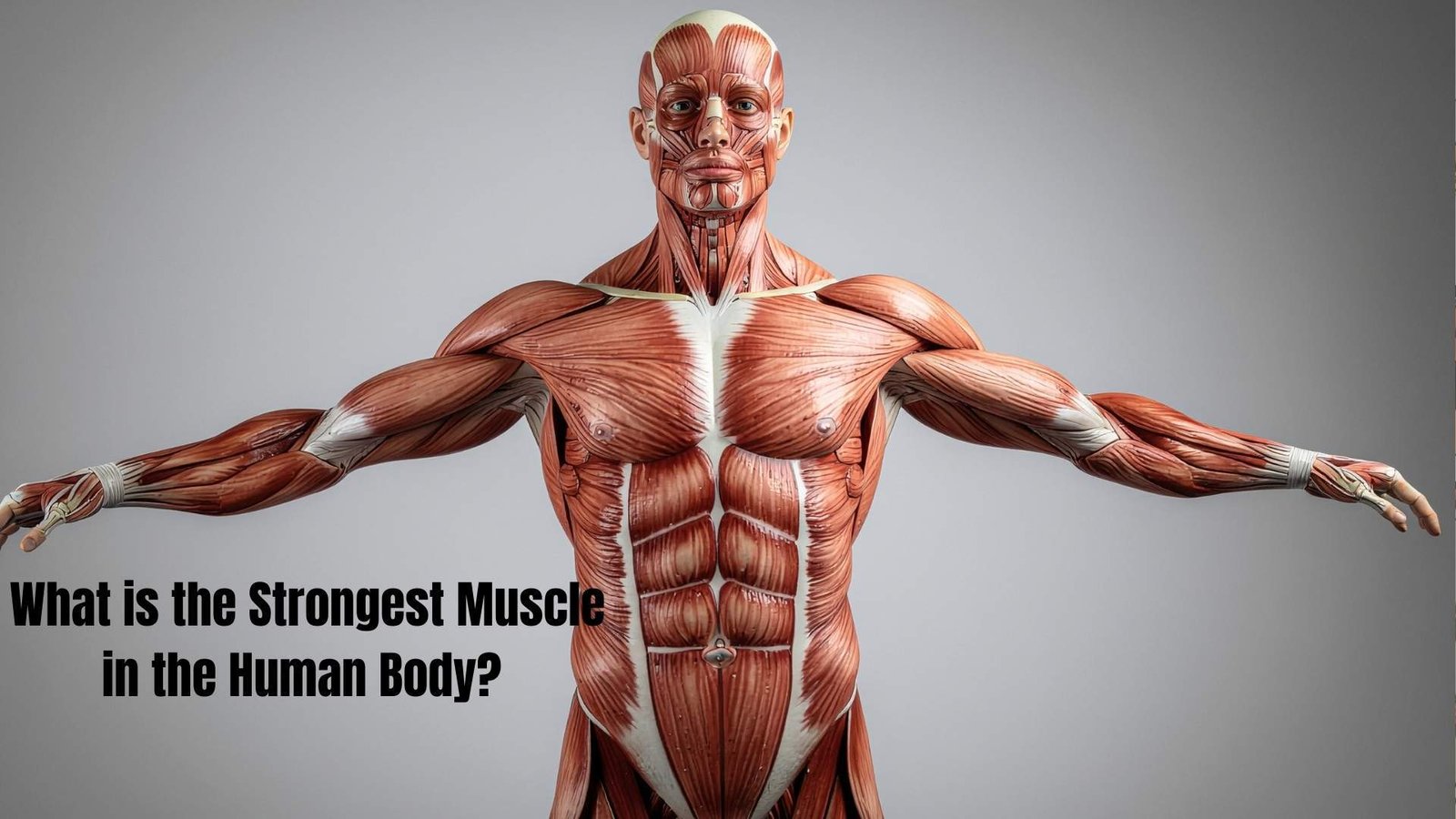
There is no simple answer to the question: what is the strongest muscle in the human body? This might surprise you. But the truth is, strength can be measured in many different ways. If you need interested info like that visit quick guider.
Some muscles are strong because they can produce maximum force. Others are strong because they work nonstop without getting tired. And some muscles are powerful because of their size.
In this article, we will explore the strongest muscles in the human body. You’ll learn about different types of muscle strength. And you’ll discover which muscles truly deserve the title of “strongest.”
Let’s dive in and explore the amazing muscular system of the human body.
Understanding Muscle Strength – Different Ways to Measure
Before we can answer which is the strongest muscle in the human body, we need to understand how we measure strength. Not all strength is the same.
Types of Strength in the Human Body
The human muscles demonstrate different kinds of strength. Here are the main types:
Absolute strength refers to the maximum amount of force a muscle can produce in a single effort. Think of this as pure power.
Dynamic strength is the ability to perform repeated motions over and over. This type of strength involves endurance and consistency.
Elastic strength means the muscle can exert force quickly. This is about speed and explosive power.
Strength endurance is the ability to resist muscle fatigue. Some muscles can work for hours or even years without stopping.
Each type of strength matters. The strongest muscle depends on which type of strength you’re measuring. This is why there’s no single answer to our question.
The Three Types of Muscles
The human body contains three main types of muscles. Each type has a different job and structure.
Cardiac muscle makes up the wall of the heart. This special muscle is responsible for pumping blood throughout your body. It contracts with great force and never stops working.
Smooth muscle lines the walls of internal organs. You’ll find smooth muscles in your intestines, uterus, blood vessels, and even inside your eyes. These are involuntary muscles that work without you thinking about them. There are billions of cellular-level muscles in this category.
Skeletal muscle attaches to your bones and skin. These are the voluntary muscles you control consciously. When you walk, lift something, or smile, you’re using skeletal muscles. They enable muscle contraction that moves your body.
The human body contains over 650 named skeletal muscles. Some experts count up to 840 different muscles depending on how they classify complex muscles.
The debate about the exact number comes from muscles with multiple parts. For example, the biceps brachii has two heads but inserts at one point called the radial tuberosity. Should we count this as one muscle or two?
Most people have the same basic set of muscles. But there are small differences from person to person. The muscle anatomy can vary slightly between individuals.
The Strongest Muscles in the Human Body – By Category
Now let’s explore the top contenders. Each of these muscles is considered the strongest muscle in a specific way. They excel at different types of force generation and muscle strength.
Masseter – The Strongest Muscle by Weight
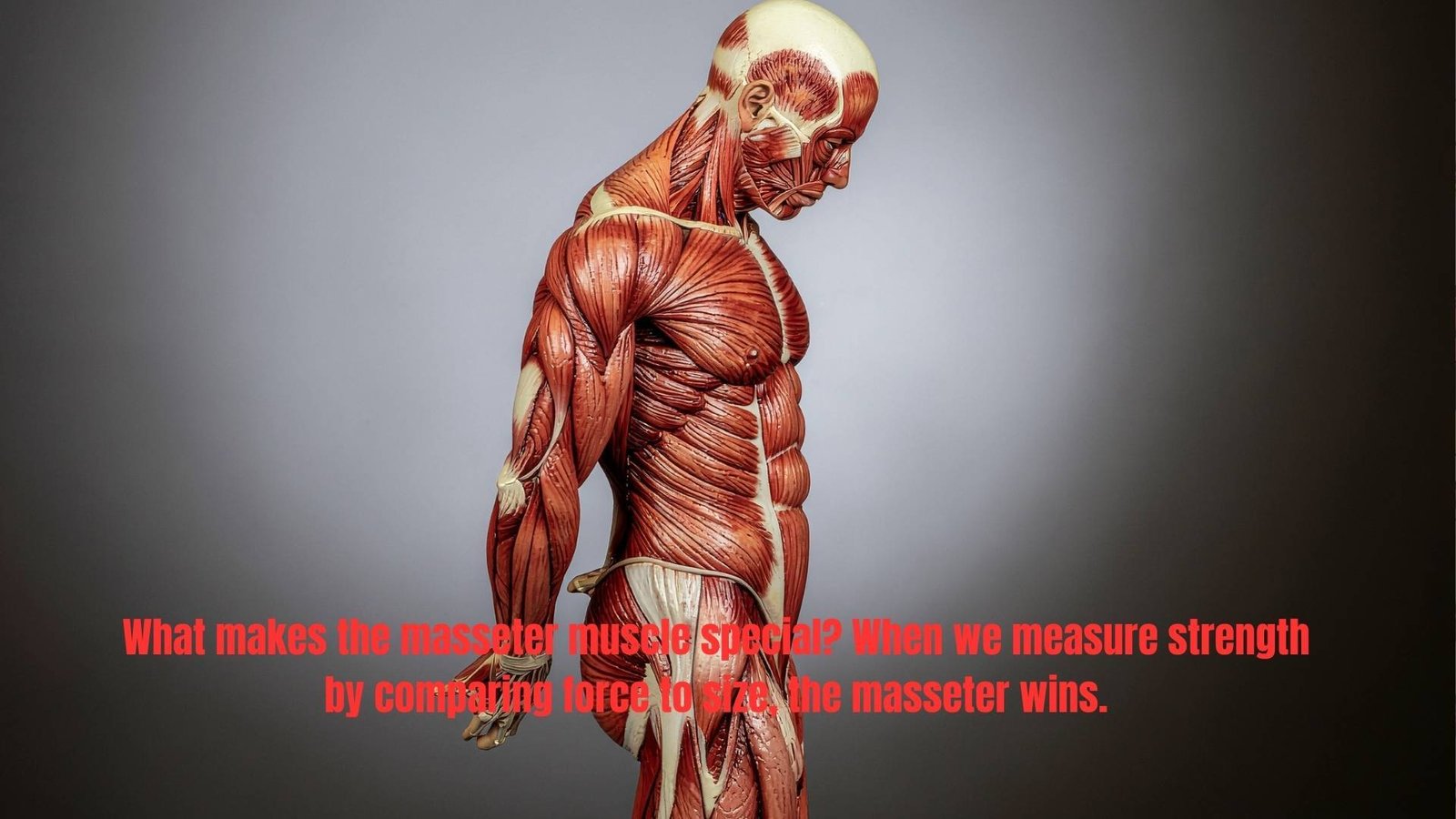
What makes the masseter muscle special? When we measure strength by comparing force to size, the masseter wins.
The masseter is your primary chewing muscle. It’s located in your jaw. This muscle might be small, but it’s incredibly powerful for its size.
The masseter muscle can generate impressive chewing force. When all your jaw muscles work together, they can close your teeth with 55 pounds of force on your incisors. On your molars, the force can reach 200 pounds (90.7 kilograms).
Think about that for a moment. A small muscle in your jaw can generate the force of a 200-pound weight. This makes it the strongest muscle by weight in the entire body.
Why is the masseter so powerful? Chewing is essential for survival. Our ancestors needed strong jaws to break down tough foods. Evolution gave us this remarkable muscle.
Heart – The Hardest Working Muscle in Your Body
The heart deserves recognition as the hardest working muscle in the human body. This unique cardiac muscle never rests from the moment you’re born until the day you die.
How much work does your heart do? The numbers are staggering. Your heart pumps out 2 ounces (71 grams) of blood with every single beat. That might not sound like much. But your heart beats about 100,000 times every day.
Over 24 hours, your heart pumps at least 2,500 gallons (9,450 liters) of blood. This continuous blood pumping keeps you alive by delivering oxygen and nutrients to every cell.
The heart can beat over 3 billion times in a person’s lifetime. No other muscle in your body works this hard for this long.
The heart’s strength comes from its endurance. It demonstrates incredible strength endurance and fatigue resistance. While your other muscles need rest, your heart keeps working every second of your life.
This blood circulation happens automatically. Your heart is an involuntary muscle that beats without conscious control. It’s truly one of the most powerful organs in the human body.
Soleus – The Muscle with the Greatest Pulling Force
Which muscle can pull with the greatest force? The answer is the soleus muscle.
The soleus sits below your gastrocnemius (calf muscle) in your lower leg. You might not think about this muscle often. But it’s working hard every time you stand, walk, or run.
The soleus is one of the most important antigravity muscles in your body. It constantly pulls against the force of gravity to keep you upright. This muscle is essential for walking and running and dancing.
Why does the soleus generate such pulling force? It has to support your entire body weight. Every time you take a step, this muscle contracts to push you forward and keep you balanced.
The soleus works together with your calf muscles as a powerful team. Together, they provide the strength needed for posture maintenance and movement. Athletes especially rely on strong soleus muscles for performance.
This muscle demonstrates both absolute strength and dynamic strength. It can produce maximum force when needed and repeat that force thousands of times each day.
Gluteus Maximus – The Largest and Most Powerful Muscle
The gluteus maximus holds the title of the largest muscle in the body. Size matters when it comes to muscle strength.
Your gluteus maximus is located in your buttocks. This massive muscle has an important job. It keeps your trunk in an upright position and enables movement.
What does the gluteus maximus do? It’s your chief antigravity muscle for the upper body. When you walk up stairs, this muscle does most of the work. It’s responsible for stair climbing and maintaining good posture.
The gluteus maximus is large and powerful because of its role. It has to support and move your entire upper body against gravity. This requires significant force generation.
This muscle works constantly throughout the day. Every time you stand up from a chair, you’re using your gluteus maximus. When you walk, run, or climb, this muscle is contracting.
The connection between muscle weight and strength is clear with the gluteus maximus. Its large size allows it to generate the power needed for daily movement and activities.
External Eye Muscles – Champions of Endurance
The external eye muscles might be tiny, but they’re champions of precision and endurance. These muscles control eye movement coordination.
Your eyes are constantly moving. Even when you think you’re staring at something still, your eye muscles are making tiny adjustments. They work to maintain a steady fixation point.
How much work do eye muscles do? During just one hour of reading, your eyes make nearly 10,000 coordinated muscle movements. That’s an incredible number of precise contractions.
These muscles demonstrate amazing dynamic strength. They perform repeated motions thousands of times per hour. Every time your head moves, the external eye muscles adjust your eye position instantly.
The external eye muscles are subject to muscle fatigue. This is why your eyes get tired after hours of reading or screen time.
These small muscles show that strength isn’t just about size or force. The external eye muscles excel at precision, speed, and endurance. They’re essential for vision and daily function.
Uterus Muscles – Remarkable Strength During Childbirth
The muscles of the uterus demonstrate incredible strength when needed most. These uterine muscles are located in the lower pelvic region.
Why are uterus muscles considered strong? During childbirth, they generate enormous force. The muscle contraction of the uterus is powerful enough to push a baby through the birth canal.
This strength doesn’t appear randomly. The pituitary gland releases a hormone called oxytocin. This oxytocin hormone stimulates powerful childbirth contractions.
The uterine muscles can contract with rhythmic, increasing force over many hours. This demonstrates both absolute strength and strength endurance. The muscles must generate maximum force repeatedly until delivery is complete.
These muscles are normally relaxed. But when activated, they become some of the most powerful muscles in the body. This on-demand strength is remarkable and essential for human reproduction.
Tongue – The Tireless Worker
Your tongue muscles are tough workers that never take a break. The tongue is made up of multiple groups of muscles working together.
What makes the tongue strong? It’s constantly in motion. The tongue helps with mixing food when you eat. It binds and twists itself to form letters when you speak. This is essential for speech formation.
Even when you sleep, your tongue keeps working. It continuously pushes saliva down your throat through swallowing saliva. This happens automatically without you thinking about it.
The tongue also contains linguinal tonsils. These structures filter out germs and protect your body from infection. So your tongue is both strong and functional for health.
The tongue shows incredible versatility. It performs complex movements for eating, speaking, and swallowing. This multi-tasking ability combined with constant use makes it one of the hardest working muscles.
Like the heart, the tongue demonstrates exceptional fatigue resistance. It rarely gets tired despite working continuously throughout your entire life.
How Muscles Are Named and Classified
Understanding muscle names helps you appreciate their function. The naming system for human muscles follows specific rules.
The Science Behind Muscle Names
Muscles receive Latin names based on six main factors. These factors describe the muscle’s characteristics and function.
Location tells you where the muscle is in the body. Muscle anatomy names often include body regions or nearby structures.
Relative size indicates if the muscle is large (maximus), medium (medius), or small (minimus).
Shape describes what the muscle looks like. Some are triangular (deltoid) while others are diamond-shaped.
Action explains what the muscle does. Words like flexor (bends a joint) or extensor (straightens a joint) describe function.
Origin and insertion refers to where the muscle attaches. The bone attachment points help identify the muscle.
Number of origins tells you if a muscle has multiple heads or starting points.
Let’s look at an example: the flexor hallucis longus. We can break down this name:
Flexor = A muscle that flexes or bends a joint
Hallucis = Related to the great toe (big toe)
Longus = Long in length
So the flexor hallucis longus is the long muscle that bends your big toe. The name perfectly describes the muscle’s function and characteristics.
This naming system helps doctors, scientists, and students understand muscles. When you know the name, you know what the muscle does and where to find it.
Fascinating Facts About Human Muscles
The muscular system contains many interesting features. Let’s explore some facts about muscles that might surprise you.
How Many Muscles Does the Human Body Have?
How many muscles are in your body? Most sources state there are over 650 named skeletal muscles. But some figures go as high as 840.
Why is there disagreement about the count? The difference comes from how we count complex muscles. Some muscles have multiple parts or heads.
Take the biceps brachii as an example. This muscle has two heads with two different origins. But both heads insert at the radial tuberosity on your arm bone. Should this count as one muscle or two?
Different anatomists make different choices. This creates the variation in muscle counts. Both numbers can be correct depending on the counting method.
What about smooth muscles? We don’t typically include smooth muscle in the count. These cellular-level muscles exist in billions throughout your organs and blood vessels. Counting them individually would be impossible.
And cardiac muscle? We only have one heart. So there’s just one cardiac muscle in the entire body, though it has different chambers and sections.
Most people have the same general set of muscles. But there is some natural variation from person to person. Your muscle anatomy might be slightly different from your neighbor’s.
Muscle Strength and Human Performance
Different muscles work together to enable human movement and performance. The muscular system functions as an integrated network.
Muscle fibers vary in type and composition. Some fibers are built for power and maximum force. Others are designed for endurance and repeated motion strength.
The coordination between muscles matters as much as individual muscle strength. When you lift something heavy, multiple muscles contract together. This teamwork creates greater force generation than any single muscle could produce.
Joint flexion and extension require pairs of muscles working in opposition. While one muscle contracts, another relaxes. This balanced system enables smooth, controlled movement.
Training can improve muscle contraction efficiency and strength. Athletes develop their muscles through specific exercises. This shows that muscle strength isn’t just about genetics—it can be enhanced.
Understanding how muscles work together helps us appreciate the complexity of the human body. Each muscle plays a specific role in the larger system of movement and posture maintenance.
So, What IS the Strongest Muscle in the Human Body?
Now we return to our original question: what is the strongest muscle in the human body?
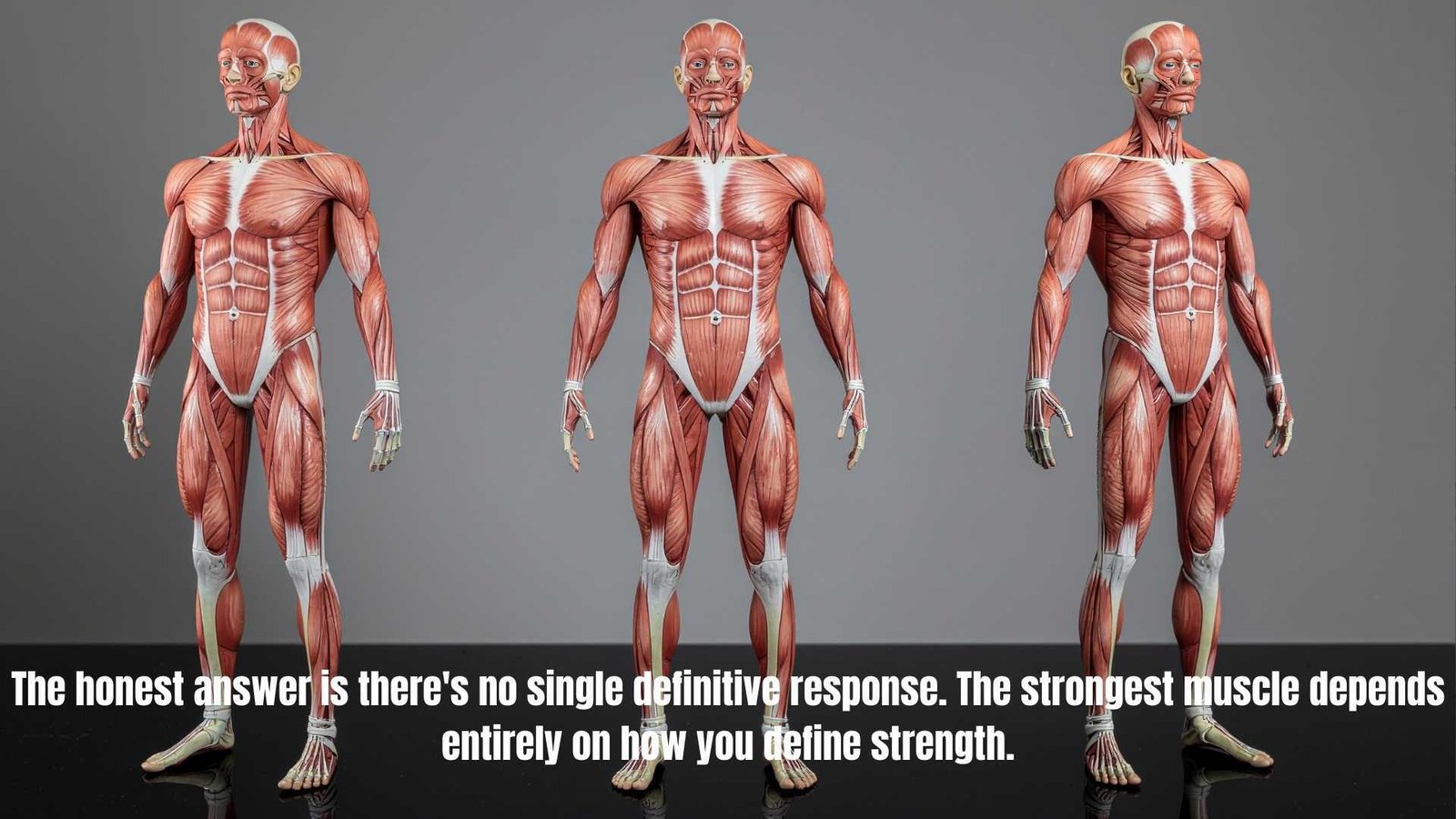
The honest answer is there’s no single definitive response. The strongest muscle depends entirely on how you define strength.
Here’s a summary of the top contenders, listed in alphabetical order:
External eye muscles win for precision and rapid coordinated muscle movements. They make thousands of adjustments every hour with remarkable accuracy.
Gluteus maximus is the largest muscle in the body and generates significant power for posture maintenance and stair climbing.
Heart is the hardest working muscle with unmatched endurance. It pumps over 2,500 gallons of blood daily and beats billions of times in a lifetime.
Masseter muscle is the strongest muscle by weight. It generates up to 200 pounds of chewing force on your molars despite its small size.
Soleus muscle produces the greatest pulling force. This antigravity muscle is essential for walking and running and keeping you upright.
Tongue muscles demonstrate versatility and constant work. They function for eating, speech formation, and swallowing saliva without rest.
Uterine muscles generate enormous force during childbirth contractions. They show that strength can be activated when needed most.
Each muscle is “strongest” in its own unique way. The human body is designed with remarkable efficiency. Every muscle is optimized for its specific function and role.
Rather than competing for a single title, these muscles work together. The muscular system functions as a coordinated whole. This cooperation is what makes human movement and survival possible.
Frequently Asked Questions About the Strongest Muscle
Is the tongue really the strongest muscle?
This is a common misconception. The tongue is not the strongest muscle in the human body when we measure force or power.
What makes the tongue remarkable? It excels at endurance and versatility. The tongue muscles work continuously without rest. They perform complex movements for eating, speaking, and swallowing.
The tongue demonstrates impressive strength endurance and fatigue resistance. But in terms of raw force or maximum force, other muscles like the masseter or soleus are stronger.
The myth probably comes from the tongue’s constant activity and flexibility. It’s certainly one of the most versatile and hardest working muscles. But it’s not the strongest by traditional measurements.
Why is the masseter considered the strongest muscle?
The masseter muscle earns its title through pound-for-pound comparison. When we measure muscle force relative to size, the masseter wins.
How strong is the masseter? It can generate 55 pounds of force on your incisors and up to 200 pounds on your molars. This is extraordinary for such a small muscle. If you want to read about this Current Local Time in Boston, Massachusetts that visit this page.
The importance of jaw strength goes back to human evolution. Our ancestors needed powerful jaws to chew tough foods. Strong chewing force was essential for survival.
This skeletal muscle demonstrates incredible force generation for its size. The masseter muscle truly is the champion when strength is measured by weight ratio.
How does the heart compare to other muscles in strength?
The heart is unique among muscles. It’s made of special cardiac muscle tissue that differs from skeletal muscle.
What makes the heart strong? Its strength comes from endurance, not raw power. The heart never rests throughout your entire life. This blood pumping continues for decades without stopping.
The heart beats over 3 billion times in an average lifetime. It pumps more than 2,500 gallons of blood every single day. This demonstrates unmatched strength endurance.
Other muscles need periods of rest to recover from muscle fatigue. The heart works continuously from birth to death. This makes it the hardest working muscle in the body, even though it might not generate the most force in a single contraction.
Can you strengthen these muscles?
Many of these muscles can be strengthened through exercise and training. But some work automatically and can’t be directly trained.
Skeletal muscles like the gluteus maximus and soleus muscle respond well to exercise. Squats strengthen your glutes. Calf raises work your soleus and gastrocnemius. These exercises improve muscle contraction and force generation.
The masseter muscle gets stronger through chewing. Though you probably don’t need to train your jaw intentionally. Normal eating provides adequate work for this muscle.
Your heart benefits from cardiovascular exercise. Activities like running, swimming, or cycling improve heart strength and efficiency. This enhances blood circulation throughout your body.
What about involuntary muscles? The tongue muscles, external eye muscles, and uterine muscles work automatically. You can’t directly train them like you would train biceps. But staying healthy overall supports their function.
Proper nutrition, hydration, and rest support all muscle fibers. A healthy lifestyle helps every muscle in your muscular system work at its best.
Conclusion
So what is the strongest muscle in the human body? As we’ve learned, there’s no single answer to this fascinating question.
Strength comes in many forms. Absolute strength, dynamic strength, elastic strength, and strength endurance all represent different types of power. Each muscle in your body excels at specific tasks.
The masseter muscle wins for force relative to size. The heart is the hardest working muscle with unmatched endurance. The soleus muscle generates the greatest pulling force. The gluteus maximus is the largest muscle with tremendous power. And the external eye muscles, tongue muscles, and uterine muscles all show remarkable capabilities. If you need info related The Top 10 Most Expensive Pokémon Cards Ever Sold visit this page.
The human body’s muscular system is a marvel of design and function. From muscle anatomy to muscle contraction, every part works together perfectly. The 650+ muscles in your body enable movement, maintain posture, and keep you alive.
Rather than searching for one “strongest” muscle, we should appreciate the diversity of muscle strength. Each muscle is optimized for its role. Together, they create the amazing capability of the human body.
Take a moment to appreciate your muscles today. From the smallest muscle fibers to the largest antigravity muscles, they’re all working hard to keep you moving and thriving. The strongest muscle in the human body is really the entire system working together as one.