
Getting your passport photo rejected wastes time and money. And most rejections happen because of one simple thing — the wrong outfit.
The good news? The US passport photo dress code is not complicated. You just need to know the rules before you step in front of that camera.
This guide covers everything — from official clothing requirements from the US State Department to expert tips no competitor will tell you. By the end, you will know exactly what to wear for a passport photo and what to leave in your closet.
Official US Passport Photo Clothing Requirements (What the State Department Actually Says)
Before anything else, let’s go straight to the source. The US Department of State sets the official rules for passport photo attire. These are not suggestions — they are requirements.
Ignoring them means your photo gets rejected. Here is what the official guidelines state:
Colors You Can and Cannot Wear for a Passport Photo
The background of a US passport photo must be plain white or off-white. That one rule controls your entire outfit decision.
Do not wear white or light-colored clothing. Your top will blend into the background, and your photo will be rejected. This is the #1 mistake applicants make.
According to the US State Department, wear clothing normally worn on a daily basis — meaning everyday clothes in darker, solid shades.
Best colors for passport photo outfits:
- Navy blue — the safest, most flattering choice
- Burgundy or maroon — rich contrast against a white background
- Dark green or forest green — works beautifully for all skin tones
- Charcoal gray — professional and clean
- Black — always accepted, always sharp
- Deep purple — bold but fully compliant
Avoid: white, cream, ivory, light yellow, pale pink, or any other light or pastel shades.
Accessories, Jewelry & Glasses Rules
Most people overlook accessories. But a single wrong piece of jewelry can get your biometric passport photo flagged.
Glasses: Remove them. The US State Department banned glasses from passport photos in 2016. The only exception is a signed doctor’s note confirming a medical necessity.
Jewelry: Allowed, but keep it minimal. Small stud earrings, a thin chain, or a simple ring are fine. Avoid large hoops, dangling earrings, or chunky necklaces. The rule is simple: jewelry must not cover your face, cast shadows, or cause glare on the photo.
Facial piercings: Permitted as long as they do not obstruct your facial features. Nose rings, eyebrow piercings, and lip rings are generally fine.
Headphones or wireless earbuds: Strictly prohibited. The only exception is a medically required hearing aid.
Head Coverings — Religious & Medical Exceptions Explained
Head coverings are not allowed in standard passport photos. But there are two official exceptions most blogs barely explain.
Religious exception: If you wear a head covering daily for religious reasons — such as a hijab, turban, yarmulke, or habit — you may keep it in your photo. You must submit a signed statement confirming it is religious attire worn daily in public.
Medical exception: If you wear a head covering due to a medical condition (such as chemotherapy-related hair loss), a signed doctor’s note must accompany your application.
Either way, the rules are strict: your full face must be completely visible, no shadows on your face, and the covering must be a single, solid color with no patterns.
Best Clothes to Wear for a Passport Photo (Expert-Approved Outfit Ideas)
Now that you know the rules, let’s talk about what actually works. These are expert-approved outfit combinations that are compliant, photogenic, and flattering.
Must Visit: What Does the Color Purple Mean? A Complete Guide to Its History, Symbolism, and Psychology
Best Colors for a Passport Photo Background Contrast
Here’s something competitors rarely explain: color contrast matters photographically, not just legally.
Against a white or off-white background, dark and medium-saturated colors create a clean separation between you and the backdrop. This makes your facial features pop and results in a crisper, more professional photo.
The science is simple: high contrast = better facial recognition. This matters for biometric passport systems that scan your photo for identification.
Passport Photo Outfit Ideas for Women
Struggling with what to wear for a passport photo as a woman? Here are proven options:
- Dark solid blouse or t-shirt — navy, black, or burgundy. Clean, simple, compliant.
- Collared button-down shirt in a dark shade — adds structure and looks polished
- Dark blazer or suit jacket over a simple top — professional and always accepted
- Dark crew-neck sweater (not turtleneck) — warm, flattering, and contrast-rich
Avoid: strapless tops, tank tops, off-shoulder blouses, or anything with patterns, logos, or glitter. Even sequined fabric can cause light reflection that ruins a photo.
Makeup tip: Keep it natural. Light foundation, subtle mascara, and a neutral lip are ideal. Heavy contouring or dark lipstick can alter your facial recognition profile in biometric systems.
Passport Photo Outfit Ideas for Men
For men, the passport photo dress code is equally straightforward:
- Dark solid t-shirt — the simplest and safest choice
- Dark polo or collar shirt — neat, clean, and works every time
- Button-down dress shirt in navy, charcoal, or dark green
- Suit jacket or blazer — the most formal acceptable option
Avoid: hoodies (they can obscure your neck and ears), camouflage clothing, military uniforms, branded sportswear, or any top with large graphic prints.
Quick tip: A plain dark t-shirt with a blazer is the single most foolproof passport photo outfit for men. It’s casual, compliant, and looks great.
What NOT to Wear for a Passport Photo (Common Mistakes That Get Photos Rejected)
This section is where most applicants go wrong. These are the exact reasons passport photos get rejected — and most of them are about clothing.
Clothing Items That Will Get Your Photo Rejected
- Uniforms — military, police, medical scrubs, or anything resembling a uniform. Strictly banned by the State Department.
- Camouflage — any camo pattern, regardless of color or style
- White or off-white clothing — blends into the background
- Strapless or tube tops — create the appearance of no clothing in the photo
- Tank tops — same problem as strapless tops
- Turtlenecks — cover the neck and can obscure chin definition, which can cause issues with automated facial recognition
- Hoodies — can hide ears and neck. If the hood is down and none of your face is covered, it may be allowed, but it’s a risk not worth taking
- Sparkly, sequined, or metallic clothing — causes glare under flash or studio lighting
- Heavily patterned clothing — stripes, florals, geometric prints. All distracting. All risk rejection
Accessories & Makeup Mistakes to Avoid
- Sunglasses or tinted glasses — always remove them
- Large statement earrings — can cast shadows on your face or neck
- Hats, beanies, baseball caps — removed unless religious or medical exemption applies
- Heavy contour makeup — can alter facial structure recognition in biometric scans
- Bold, dark lipstick — can interfere with lip-line detection in automated passport photo verification systems
- Wireless earbuds or AirPods — explicitly prohibited
Hair Mistakes That Cause Passport Photo Rejection
This is the section competitors almost never cover properly. Hair rules matter — and they directly affect whether your photo is accepted.
The State Department requires your full face to be clearly visible. That means:
- Hair must not fall across your eyes or eyebrows
- Hair must not cover your ears if it causes ambiguity about face width in biometric scans
- Large hair accessories like wide headbands, thick scrunchies, or decorative clips are not allowed
- Big, voluminous hairstyles are fine, as long as they do not cast shadows on your face
Hair up or down? Either is fine — as long as your full face and facial features are clearly visible. (We cover this more in the FAQ below.)
Passport Photo Dress Code for Special Cases (What Other Blogs Don’t Tell You)
This is the section most travel and photo blogs skip entirely. But for many Americans, these special case dress code rules are exactly what they need to know.
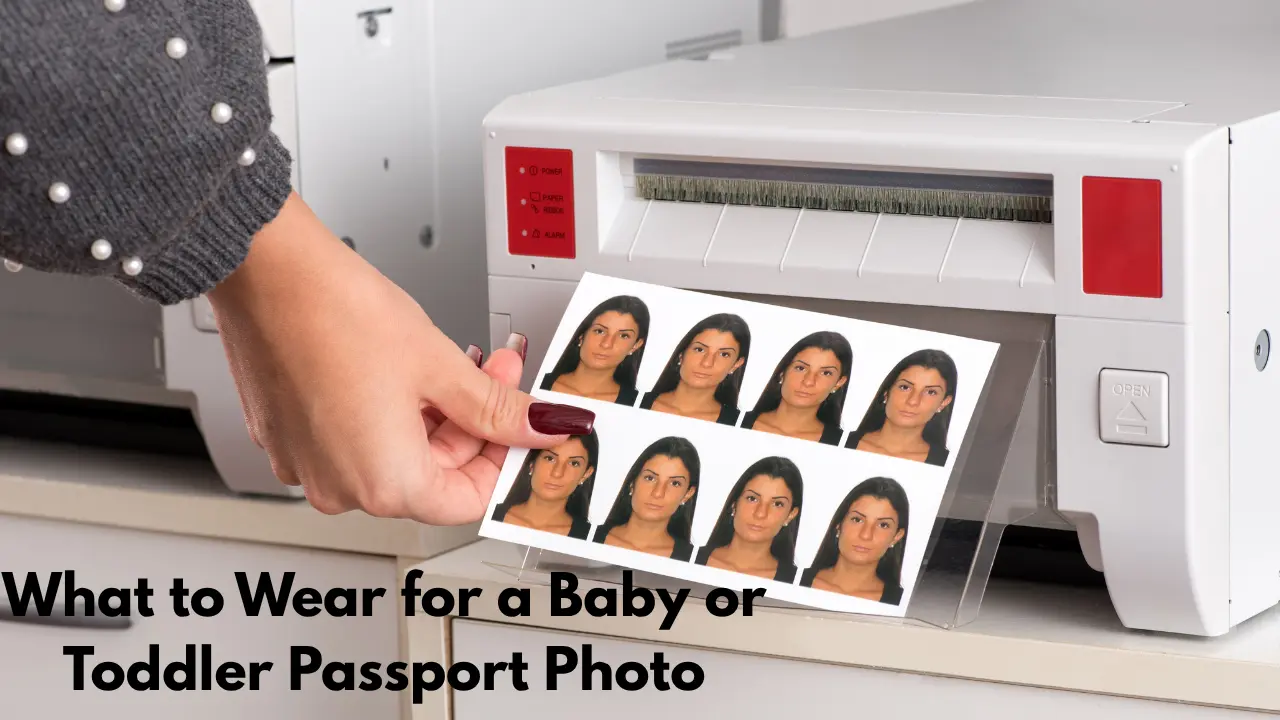
What to Wear for a Baby or Toddler Passport Photo
Yes — babies need passport photos too, and the same dress code applies. Here is how to handle it:
- Dress your baby in a dark, solid-color onesie or outfit — navy, green, or dark gray work well
- Avoid white baby clothes — they disappear against the white background
- Lay your baby on a plain white or off-white sheet — a car seat covered with a white sheet works perfectly
- No bibs, hats, or hair accessories during the photo
According to the US State Department, it is okay if a baby’s eyes are not fully open. All other children must have eyes open.
Passport Photo Dress Code If You Wear a Hijab or Religious Attire
If you wear a hijab, turban, yarmulke, or any daily religious head covering, you are allowed to keep it in your passport photo. Here is the exact process:
- Step 1: Write and sign a statement confirming the head covering is religious attire worn daily in public
- Step 2: Submit this statement alongside your passport application
- Step 3: Ensure the covering is solid-colored, without patterns, and that your full face is completely visible
- Step 4: No part of your face — including forehead, chin, or cheeks — should be covered or in shadow
This is a legal accommodation under US law. You will not be denied for wearing religious attire if you follow these steps exactly.
What to Wear for a Passport Photo If You Have a Medical Condition
Medical conditions can affect your passport photo attire in two key ways — glasses and head coverings.
If you need glasses for medical reasons: You may wear them, but you must include a signed note from your doctor with your application. The note must state that you cannot remove your glasses. Even with this exception, tinted or reflective lenses are not allowed.
If you wear a head covering due to illness (such as cancer treatment): A signed doctor’s statement confirming the medical need must be submitted. The same face-visibility rules apply — full face, no shadows, solid color covering.
Quick Passport Photo Dress Code Checklist Before You Shoot
Run through this pre-shoot checklist before taking your passport photo. It takes 30 seconds and can save you weeks of delay.
- ✅ Clothing color: Dark and solid — navy, black, burgundy, charcoal, or dark green
- ✅ No patterns: No stripes, florals, logos, or prints
- ✅ No uniforms: No military, police, medical, or work uniforms
- ✅ No camouflage: Any camo is automatically rejected
- ✅ No white clothing: Will blend into the background
- ✅ No strapless or tank tops: Choose a top with sleeves
- ✅ Glasses off: Remove all eyewear (exception with doctor’s note only)
- ✅ Hats off: Remove all head coverings (exception with documentation)
- ✅ Jewelry minimal: Small, non-reflective pieces only
- ✅ Hair clear of face: Eyebrows, eyes, and full face visible
- ✅ Makeup natural: No heavy contour or bold lip color
- ✅ No earbuds or headphones: Remove all wireless devices
FAQ — Passport Photo Dress Code Questions Answered
What is the best color to wear for a passport photo?
Navy blue is widely considered the best color for a passport photo outfit. It contrasts sharply with the white background, flatters most skin tones, and is universally accepted by passport agencies. Other excellent choices include burgundy, charcoal gray, dark green, and black. Avoid white, cream, or any light color — they will blend into the background.
What is the dress code for passport photos?
The US passport photo dress code, set by the US Department of State, requires everyday clothing in darker, solid colors. You cannot wear uniforms, camouflage, white clothing, hats, glasses, or strapless tops. No patterns, logos, or sparkly fabrics. Your full face must be visible at all times. Jewelry is allowed if it does not cause glare or cover your face.
What can I not wear in a passport photo?
You cannot wear: uniforms, camouflage, white or light-colored clothing, strapless or tank tops, turtlenecks, hoodies, hats or head coverings (without documentation), glasses or sunglasses (without a medical note), patterned or logoed clothing, sparkly or metallic fabrics, or wireless earbuds or headphones. Any of these can result in your passport photo being rejected by a passport agent.
Should you wear your hair up or down for a passport photo?
There is no official rule on hair up vs. hair down for passport photos. Both are accepted. The only requirement is that your full face is clearly visible — including your forehead, eyebrows, eyes, and chin. If wearing your hair down causes it to fall across your face or cast shadows on your facial features, pull it back. If both styles keep your face fully visible, choose whichever you prefer.
Conclusion
The passport photo dress code is simpler than most people think. Wear dark, solid, everyday clothing. Keep accessories minimal. Remove glasses and hats. Make sure your full face is visible with no shadows or obstructions.
If you have a special case — religious attire, a medical condition, or a baby — now you know the exact steps to follow.
Follow this guide, run the checklist, and your passport photo outfit will be compliant the first time. No delays. No rejections. Just a valid photo ready to go.