
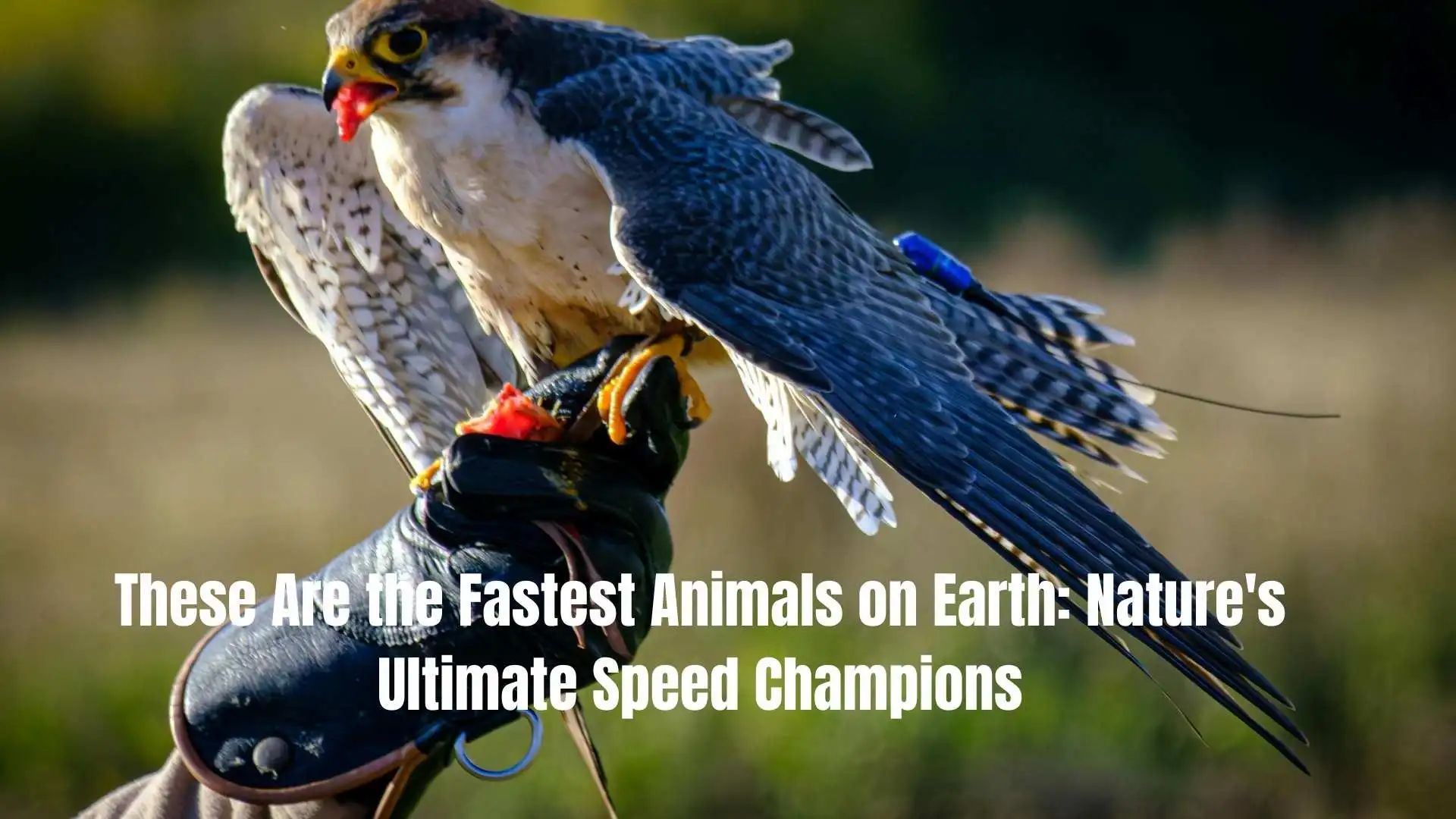
 These Are the Fastest Animals on Earth: Nature’s Ultimate Speed Champions. Speed is one of nature’s most incredible gifts. It helps animals survive in the wild. Some use it to catch food. Others need it to escape danger. From the sky to the land to the ocean, speed adaptation shapes how animals live and thrive. If you need more interested info like that visit quick guider.
The fastest animals on Earth come in all shapes and sizes. They live in different parts of the world. Each one has evolved special abilities to reach amazing speeds. Some fly through the air at breathtaking velocity. Others race across savannahs and grasslands. And some cut through ocean waters like living torpedoes.
But here’s something important to remember. Many of the world’s speediest creatures face serious threats today. Habitat loss, climate change, and human activity put them at risk. Organizations like IFAW (International Fund for Animal Welfare) work hard to protect these amazing animals. They rescue injured wildlife. They fight illegal wildlife trade. And they help animals and people live together in harmony.
Let’s explore the fastest animal in the world and meet 19 other incredible speed champions. You’ll discover how fast they can really go. You’ll learn why they need such amazing speed. And you’ll find out how you can help protect them.
Why Speed Matters in the Animal Kingdom
The Science Behind Animal Speed
Animal speed isn’t just about going fast. It’s about survival.
In nature, speed gives animals major advantages. Fast hunters catch more food. Quick prey animals escape predators. Swift flyers cover huge distances during migration. Speed can mean the difference between life and death.
But speed comes with trade-offs. Animals built for velocity often sacrifice other traits. Cheetahs are fast but not very strong. They’re smaller than lions and tigers. This makes them vulnerable when bigger predators show up. Fast-flying birds might have less endurance. Speedy fish might be more fragile. If you want to read about The Top 10 Most Expensive Pokémon Cards Ever visit this page.
Evolution shaped each animal differently. Bodies adapted over millions of years. Long legs help land animals run faster. Streamlined bodies help fish swim quicker. Special feathers and wing shapes help birds dive at incredible speeds.
How Scientists Measure Animal Speed
Measuring animal kingdom speeds isn’t easy.
For flying animals, scientists use different methods. Radar tracking follows birds of prey through the sky. High-speed cameras capture their movements. GPS devices attached to birds record their speeds during flight.
But there’s a catch. Diving speed is different from level flight speed. A peregrine falcon reaches its top speed while plummeting toward prey. That’s much faster than when it flies horizontally. Scientists have to be clear about which type of speed they’re measuring.
For land animals, researchers use speed guns and timing equipment. They measure running speed over known distances. They calculate acceleration rate by watching how quickly animals reach top velocity.
In the ocean, measuring marine speed gets even trickier. Scientists use underwater cameras and sonar. They track tagged fish over time. But ocean currents and water conditions affect accuracy.
All measurements use standard units. Kilometers per hour (km/h) is common worldwide. In the United States, miles per hour (mph) is more familiar. This article uses both.
The Fastest Birds on Earth: Masters of the Sky
Peregrine Falcon – The Ultimate Speed Record Holder
The peregrine falcon holds the crown. It’s the fastest animal in the world. Period.
These incredible birds of prey can dive at speeds over 320 km/h (200 mph). That’s faster than a race car on the highway. When a Falco peregrinus spots prey below, it tucks its wings and drops like a missile. The force and precision are stunning.
Peregrine falcons are found almost everywhere. They live on every continent except Antarctica. You can spot them in North America, Europe, Asia, Africa, and South America. They’ve even adapted to urban environments, nesting on tall buildings and bridges.
These raptors are surprisingly large. They measure 36 to 49 centimeters (14.2 to 19.3 inches) long. Their wingspan stretches 100 to 110 centimeters (39.4 to 43.3 inches). They weigh between 530 and 1,600 grams (18.7 to 56.4 ounces).
Peregrine falcons hunt other birds in mid-air. They use their incredible diving velocity for ambush hunting. The impact from their strike often kills prey instantly. Their speed makes them extremely successful hunters.
The conservation story here is remarkable. In the United States, these falcons almost went extinct in the 1970s. The chemical DDT poisoned them across the country. The government listed them as endangered species under the Endangered Species Act. When DDT was finally banned, populations recovered. By 1999, the peregrine falcon was removed from the endangered list.
Today, the IUCN Red List classifies them as least concern. But they still face threats. At IFAW’s Beijing Raptor Rescue Center, workers rescue injured peregrines. Many get hurt flying into buildings, windows, and power lines. Lead poisoning and rat poison also harm them. Changing weather patterns confuse migratory birds and affect their food supply.
Golden Eagle – The Second Fastest Flyer
The golden eagle takes second place among the fastest flying animals.
These massive raptors dive toward prey at speeds exceeding 240 km/h (150 mph). That’s incredibly fast, even if it doesn’t match the peregrine falcon. When a golden eagle (scientific name Aquila chrysaetos) locks onto a target, few animals can escape.
Golden eagles live throughout the Northern Hemisphere. You’ll find them in countries like the United Kingdom, Canada, the United States, Russia, Norway, and China. They prefer mountains, cliffs, and wide-open spaces.
These are big birds. They’re much larger than peregrine falcons. Golden eagles measure 70 to 84 centimeters (27.6 to 33.1 inches) long. They weigh three to six kilograms (6.6 to 13.5 pounds). Their wingspan is impressive—185 to 220 centimeters (72.8 to 86.6 inches).
Their diving speed helps them catch food. But it also helps them escape danger when needed. These powerful hunters eat rabbits, hares, and even young deer.
The species has a stable population. Around 160,000 mature individuals live worldwide. The IUCN lists them as least concern. In the United States, golden eagles are protected under the Migratory Bird Treaty Act. They’re also listed under CITES Appendix II. This protects them from unsustainable trade.
White-Throated Needletail – Speed in Level Flight
The white-throated needletail is different from diving birds.
This small bird reaches its top speed during horizontal flight. It doesn’t need to dive. Scientists believe the Hirundapus caudacutus can fly up to 168 km/h (105 mph) in level flight. That’s never been scientifically proven with complete certainty. But the evidence suggests it’s true.
These birds belong to the swift family. They live in parts of Asia and Oceania. They’re built for speed and endurance. Long-distance travel is their specialty.
White-throated needletails have unusual body proportions. Their wingspan measures around 50 centimeters (19.68 inches). But their bodies are only about 20 centimeters (7.87 inches) long. This big wing-to-body ratio is perfect for speed.
There’s a downside though. These birds struggle to take off from the ground. So they spend most of their time flying. They rarely perch. They eat insects in mid-air. They even sleep while gliding on wind currents.
The population size isn’t exactly known. But scientists believe it’s stable. The IUCN classifies the white-throated needletail as least concern.
Eurasian Hobby – The Agile Hunter
The Eurasian hobby is another falcon built for speed.
This bird reaches speeds up to 160 km/h (100 mph) when diving. The Falco subbuteo lives across much of Europe, Asia, and Africa. It’s smaller than the peregrine falcon but just as impressive.
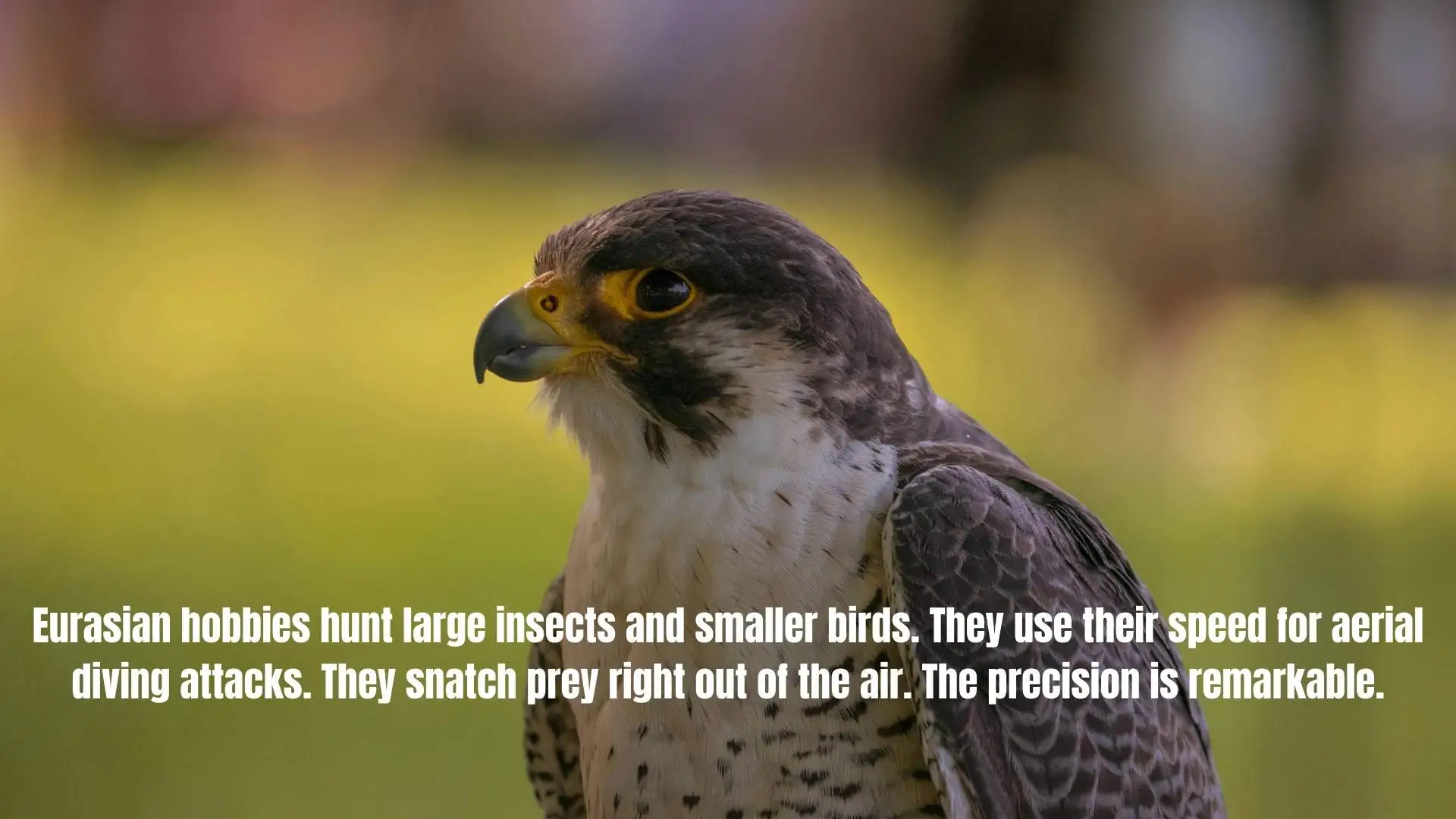
Eurasian hobbies hunt large insects and smaller birds. They use their speed for aerial diving attacks. They snatch prey right out of the air. The precision is remarkable.
These falcons measure 29 to 36 centimeters (11.4 to 14.2 inches) long. They weigh 131 to 340 grams (4.6 to 12 ounces). Their wingspan averages 74 to 84 centimeters (29.1 to 33.1 inches).
About 1,500,000 mature Eurasian hobbies exist worldwide. The IUCN lists them as least concern. But there are troubling signs. The population appears to be decreasing. Scientists monitor the trend carefully.
Gyrfalcon – Arctic Speed Specialist
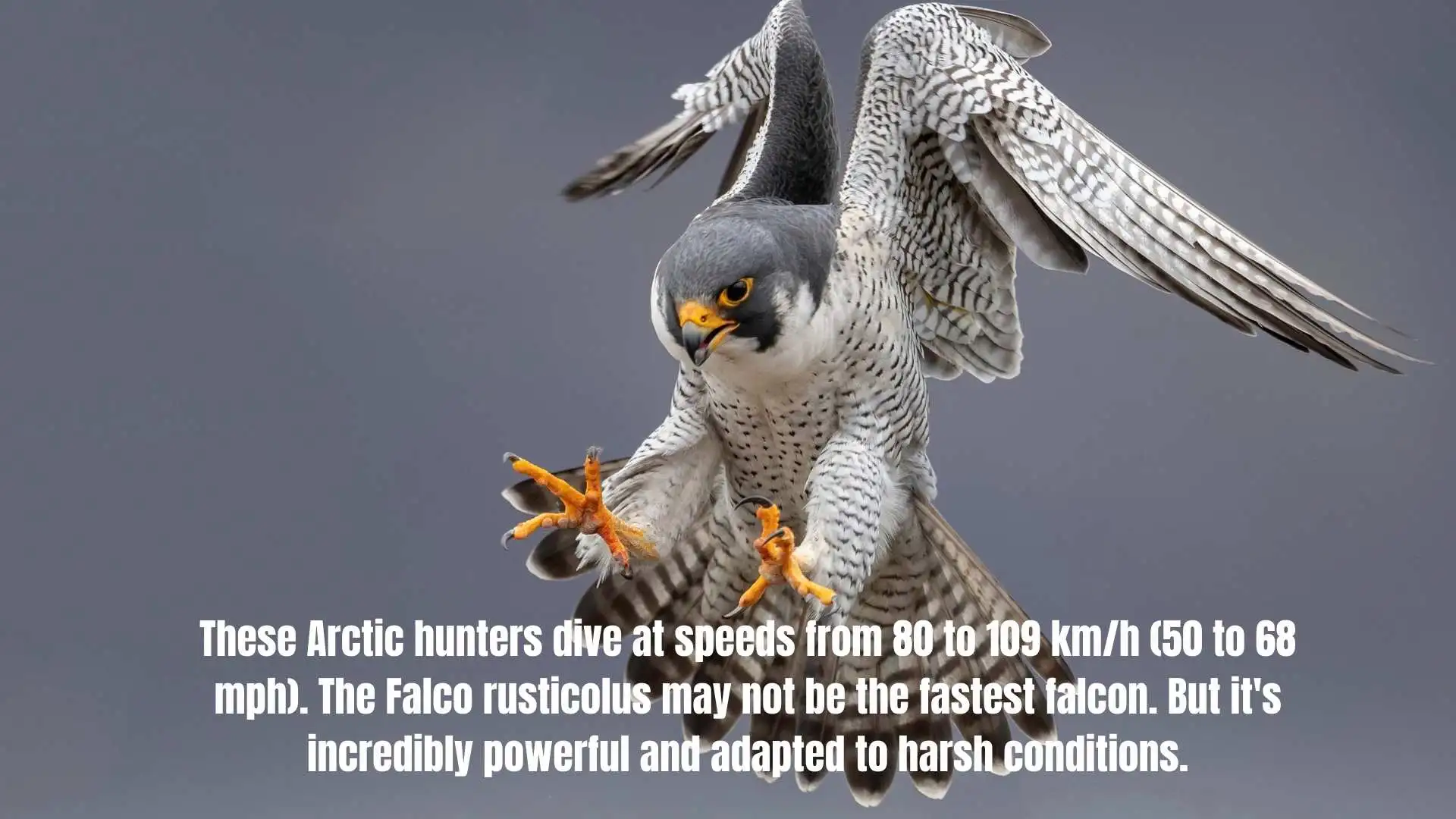
The gyrfalcon is the world’s largest falcon species.
These Arctic hunters dive at speeds from 80 to 109 km/h (50 to 68 mph). The Falco rusticolus may not be the fastest falcon. But it’s incredibly powerful and adapted to harsh conditions.
Gyrfalcons measure 48 to 65 centimeters (18.9 to 25.6 inches) long. They weigh 805 grams to two kilograms (1.76 to 4.4 pounds). Their wingspan stretches 110 to 160 centimeters (43.3 to 63 inches).
These birds live primarily above the Arctic Circle. You’ll find them in Canada, Finland, Greenland, Iceland, Norway, Sweden, and Russia. They hunt in freezing conditions where most birds couldn’t survive.
Gyrfalcons eat ptarmigans and waterfowl. They need speed to catch prey before it escapes into cover. In the Arctic, opportunities don’t last long.
The population is stable. Between 12,600 and 55,300 mature individuals exist. The IUCN classifies them as least concern. They’re protected under CITES Appendix I and the Convention on the Conservation of Migratory Species of Wild Animals.
But scientists worry about climate change. Rising temperatures affect the Arctic Circle dramatically. More research is needed to understand how warming impacts gyrfalcon populations.
Other Notable Fast-Flying Birds
Several other birds deserve recognition for their speed.
Frigatebirds are fascinating ocean flyers. The magnificent frigatebird reaches speeds around 74 km/h (46 mph). Five species exist in this family. They live in tropical and subtropical oceans worldwide.
These birds practice kleptoparasitism. They steal food from other birds using their speed and agility. They also hunt their own prey. Frigatebirds spend weeks at a time in flight. They use wind currents to conserve energy.
Albatrosses are legendary long-distance flyers. The snowy albatross (Diomedea exulans) can reach 72 km/h (45 mph). Twenty-two species make up the albatross family. They live across the Southern Hemisphere and North Pacific.
Albatrosses accelerate to high speeds. Then they glide on wind for hours. This lets them cover vast distances with minimal effort. Sadly, seven species are endangered species. Two are critically endangered. They face threats from climate change, fishing bycatch, and hunting.
Anna’s hummingbird is a tiny speed demon. This Calypte anna flies at 96 km/h (60 mph). Unlike other birds on this list, hummingbirds use speed for courtship displays. Males dive at high velocity to impress females.
The spur-winged goose is the fastest waterfowl. These birds reach 142 km/h (88 mph) in flight. They live in sub-Saharan Africa near rivers, lakes, and swamps. They use speed to escape predators and migrate long distances.
Even common pigeons deserve mention. The rock dove (Columba livia) usually flies at 24 to 56 km/h (15 to 35 mph). But trained pigeons can reach 156 km/h (97 mph) in short bursts. These birds adapted to urban environments worldwide. About 260,000,000 pigeons exist globally.
The Fastest Land Animals on Earth: Speed on Solid Ground
Cheetah – The Undisputed Land Speed Champion
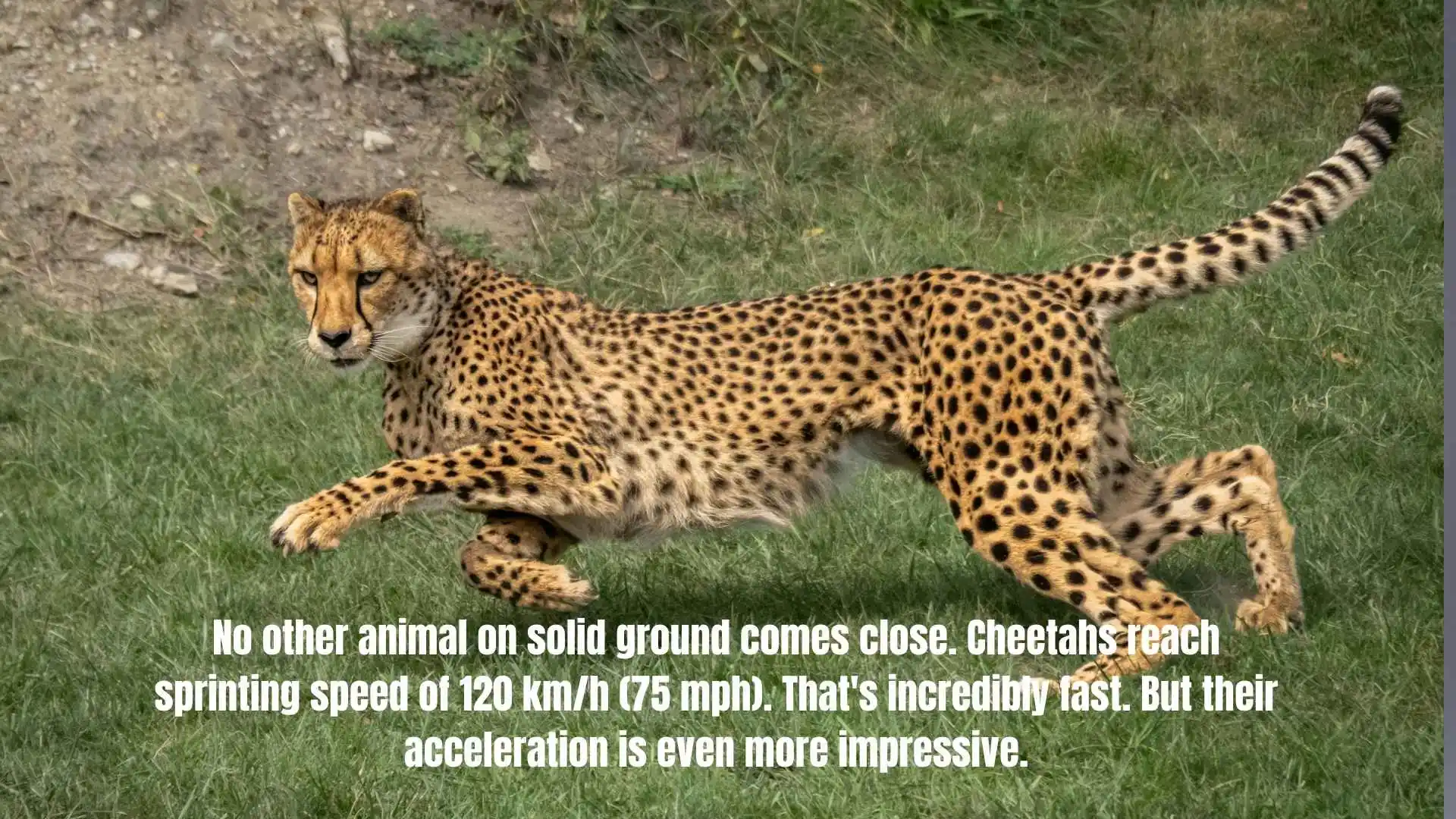
The cheetah is the fastest land animal on the planet.
No other animal on solid ground comes close. Cheetahs reach sprinting speed of 120 km/h (75 mph). That’s incredibly fast. But their acceleration is even more impressive.
A cheetah can increase its speed by 10 km/h in a single stride. Think about that. From standing still, they hit 96 km/h (60 mph) in just three seconds. That beats most sports cars.
The scientific name is Acinonyx jubatus. These big cats live primarily in Africa. A small population also exists in Iran. But their range has shrunk dramatically over time.
Cheetahs are built differently than other big cats. They’re smaller and lighter than lions and tigers. An adult cheetah measures 1.1 to 1.4 meters (3.7 to 4.6 feet) long. They weigh 34 to 54 kilograms (77 to 143 pounds).
This smaller size is key to their speed. Lions reach only 80 km/h (50 mph). Tigers max out at 64 km/h (40 mph). Leopards hit 58 km/h (36 mph). The cheetah leaves them all behind.
Special adaptations make this possible. Long, slender legs act like springs. A flexible spine extends and contracts with each stride. Large nasal passages take in more oxygen. Semi-retractable claws grip the ground like track spikes. A long tail provides balance during sharp turns.
Cheetahs use their speed for hunting prey. Their favorite targets are gazelles and other fast antelope. The hunt is quick and intense. Cheetahs can’t maintain top speed for long. They sprint in short bursts lasting 20 to 30 seconds. If they don’t catch prey quickly, they give up to avoid overheating.
But here’s the heartbreaking part. Cheetahs are in serious trouble.
Only about 6,517 mature individuals remain in the wild. The population keeps decreasing. The IUCN Red List classifies them as vulnerable species. They’re listed under CITES Appendix I, which gives them the highest protection from trade.
Cheetahs disappeared from most of their historical range. Habitat loss is a major problem. Human development destroys the savannahs and grasslands they need. Conflict with livestock farmers leads to killings.
The trafficking of live cheetah cubs is another crisis. Poachers steal babies from the wild in the Somali region. They smuggle them to the Arabian Peninsula. Wealthy buyers want them as exotic pets. Most cubs die during transport or in captivity.
IFAW fights this through their Countering Cheetah Trafficking from the Horn of Africa to the Arabian Peninsula project. They work to stop the illegal wildlife trade. They rescue trafficked cubs. They raise awareness about the problem. And they push for stronger enforcement.
Springbok – The Pronking Speedster
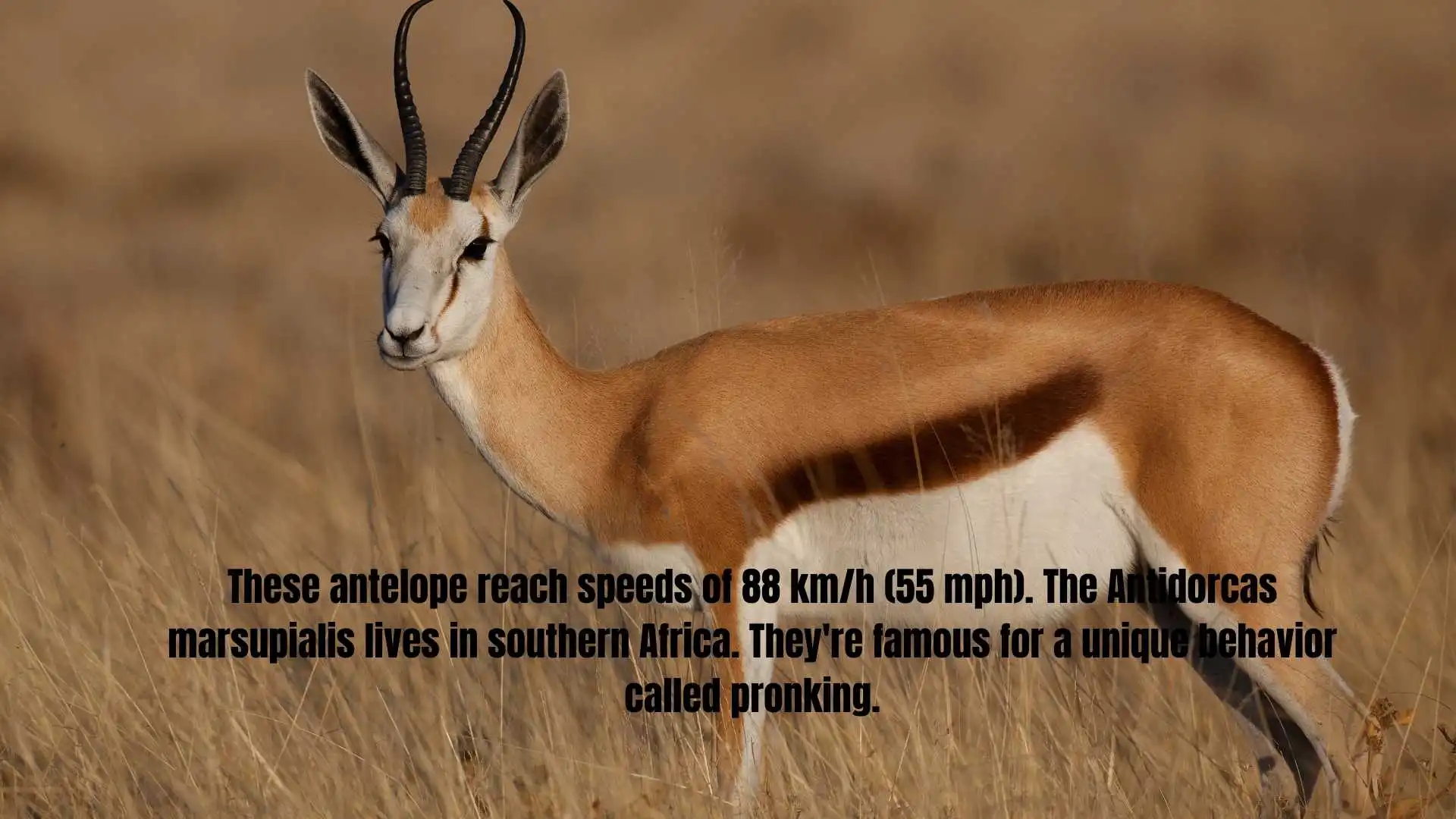
The springbok is one of Africa’s most distinctive speedsters.
These antelope reach speeds of 88 km/h (55 mph). The Antidorcas marsupialis lives in southern Africa. They’re famous for a unique behavior called pronking.
Pronking looks amazing. The springbok leaps straight up into the air. All four feet leave the ground at once. They arch their back and stiffen their legs. They can jump over two meters high. Scientists think pronking helps them spot predators. It might also signal fitness to other springboks.
But springboks don’t just jump. They run fast too. This speed helps them escape lions, cheetahs, leopards, and wild dogs. Escaping predators is a daily challenge on the African plains.
The good news? Springboks are doing well. The population includes 1,400,000 to 1,700,000 mature individuals. The IUCN classifies them as least concern.
American Quarter Horse – Domesticated Speed
The American quarter horse proves that selective breeding works.
Humans bred this Equus caballus for hundreds of years. They selected for specific traits, including incredible sprinting speed. The result? A horse that reaches 88 km/h (55 mph).
American quarter horses are sprinters, not distance runners. They’re named for their ability to outrun other horses in quarter-mile races. That explosive acceleration makes them perfect for ranch work, rodeos, and racing.
Over 2.5 million American quarter horses live in the United States alone. They’re the most popular horse breed in the country. Worldwide, millions more exist on every continent.
Blue Wildebeest – Migration Marathon Runner
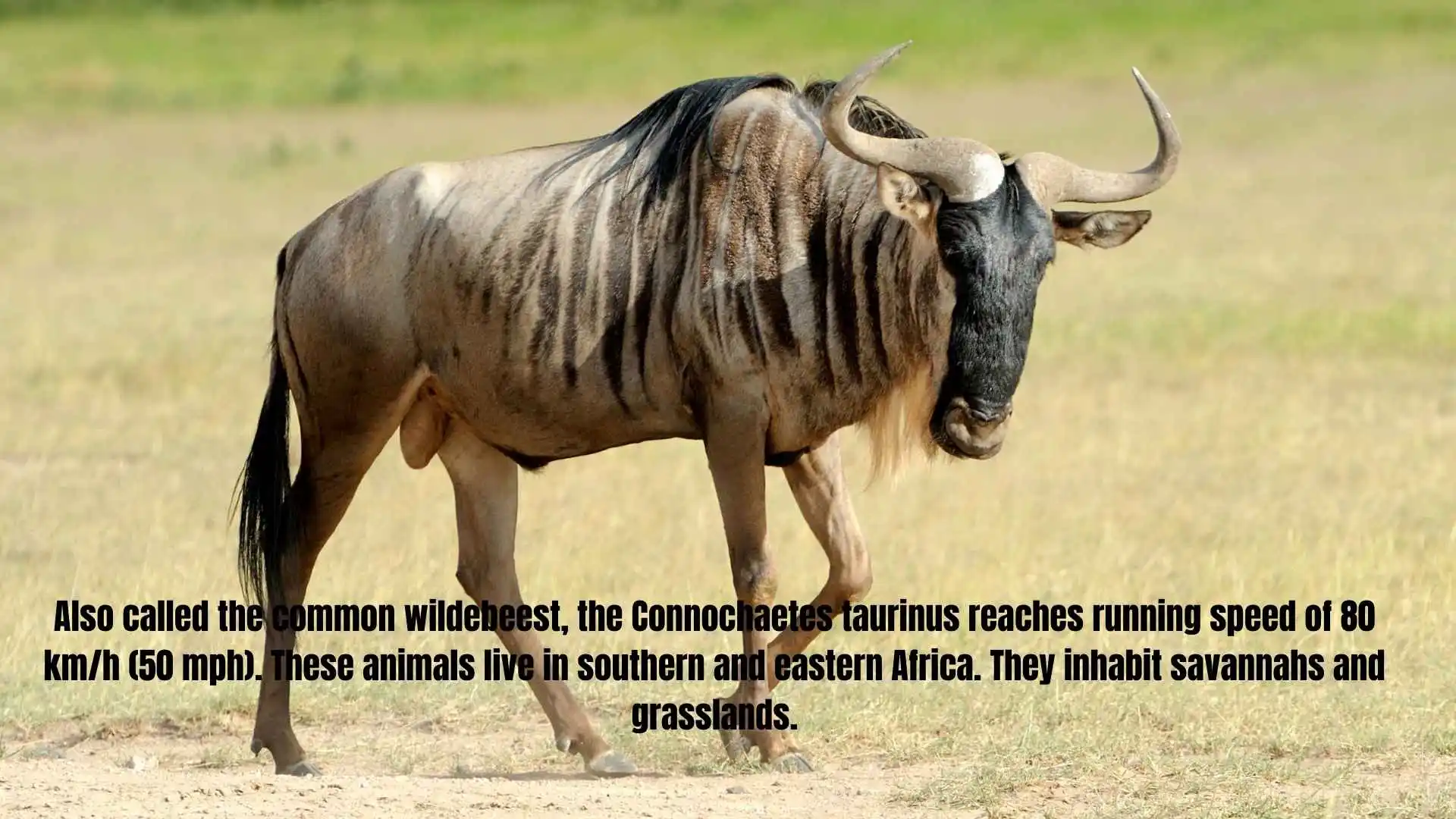
The blue wildebeest combines speed with endurance.
Also called the common wildebeest, the Connochaetes taurinus reaches running speed of 80 km/h (50 mph). These animals live in southern and eastern Africa. They inhabit savannahs and grasslands.
Blue wildebeests are famous for their massive migrations. Huge herds move across the landscape seeking fresh grazing. During these journeys, speed becomes critical. Lions, hyenas, cheetahs, and leopards all hunt wildebeests.
The population is healthy. About 1,550,000 mature individuals exist. The IUCN lists them as least concern with a stable population.
Pronghorn – America’s Endurance Runner
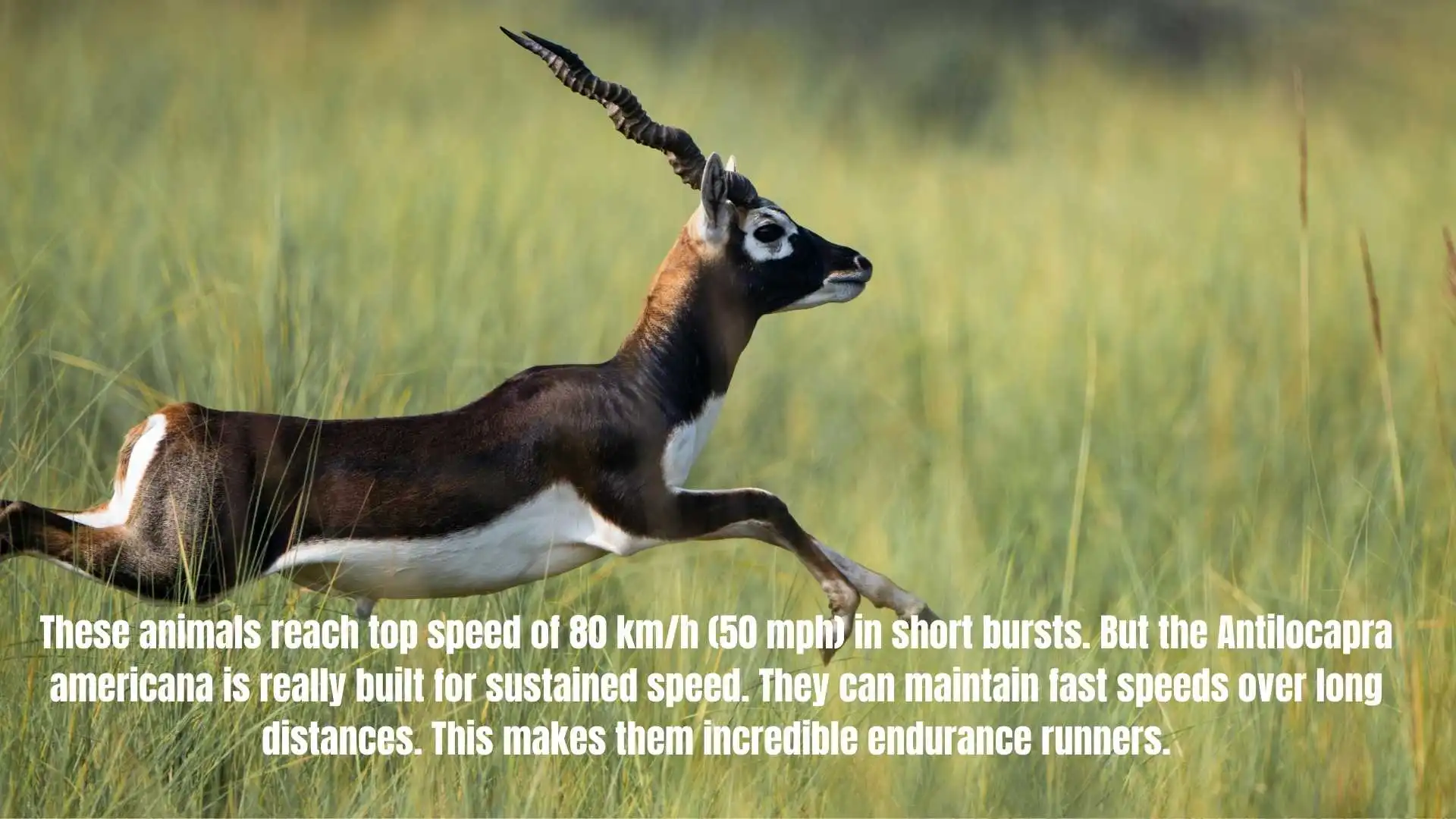
The pronghorn is North America’s speed champion.
These animals reach top speed of 80 km/h (50 mph) in short bursts. But the Antilocapra americana is really built for sustained speed. They can maintain fast speeds over long distances. This makes them incredible endurance runners.
Pronghorns live in western North America. They migrate 240 kilometers (150 miles) each way during the year. One of their closest living relatives is the giraffe. That’s surprising considering how different they look.
These animals evolved to outrun prehistoric predators that no longer exist. American cheetahs once roamed North America. Pronghorns kept their speed even after those predators went extinct.
Today, around 750,000 mature pronghorns exist. The population is stable. The IUCN classifies them as least concern.
Thomson’s Gazelle – Agility Meets Speed
Thomson’s gazelle combines speed with incredible agility.
The Eudorcas thomsonii reaches speeds up to 64 km/h (40 mph). But it’s their ability to change direction that really impresses. These small antelope can turn and twist while running at full speed. This makes them hard targets for predators.
Thomson’s gazelles live in East Africa. They prefer wide-open spaces where they can see danger coming. Good visibility helps them survive.
Their running speed helps during migration. It’s also critical for escaping predators. Lions, cheetahs, leopards, and wild dogs all hunt these gazelles.
About 145,000 mature individuals exist. The IUCN lists them as least concern.
Ostrich – The Fastest Flightless Bird
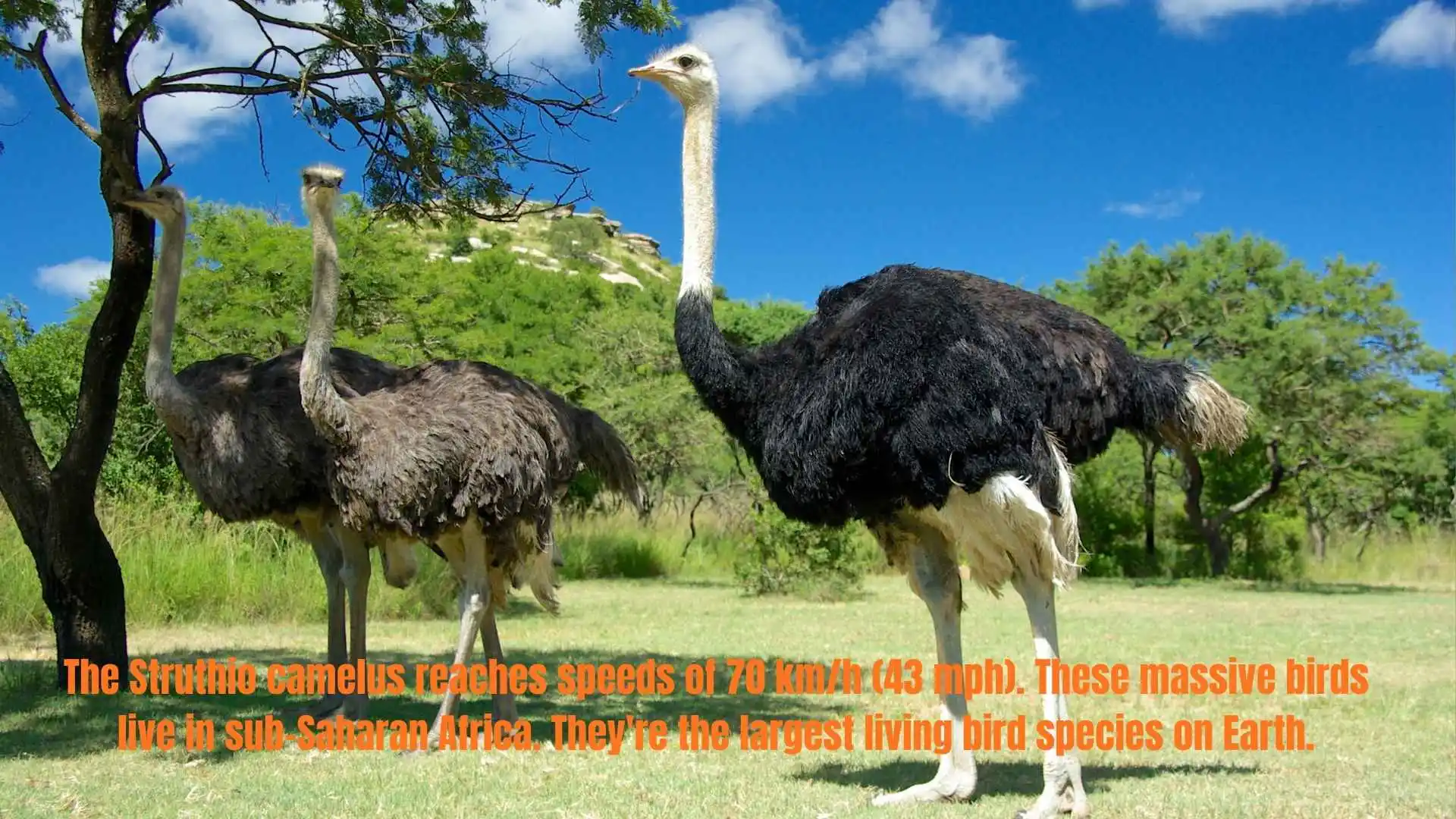
The common ostrich can’t fly. But it sure can run.
The Struthio camelus reaches speeds of 70 km/h (43 mph). These massive birds live in sub-Saharan Africa. They’re the largest living bird species on Earth. If you need info related What Is a Clove of Garlic visit this page.
Ostriches eat mostly plants. So they don’t use speed for hunting prey. Instead, they run to escape danger. Lions, hyenas, and leopards all hunt adult ostriches. Smaller predators target eggs and chicks.
Long, powerful legs give ostriches their speed. Each stride covers huge distances. They can maintain fast speeds for extended periods.
The population appears to be decreasing. But common ostriches are still listed as least concern by the IUCN. They’re not in immediate danger.
The Fastest Marine Animals on Earth: Ocean Speed Demons
Sailfish – The Ocean’s Fastest Swimmer
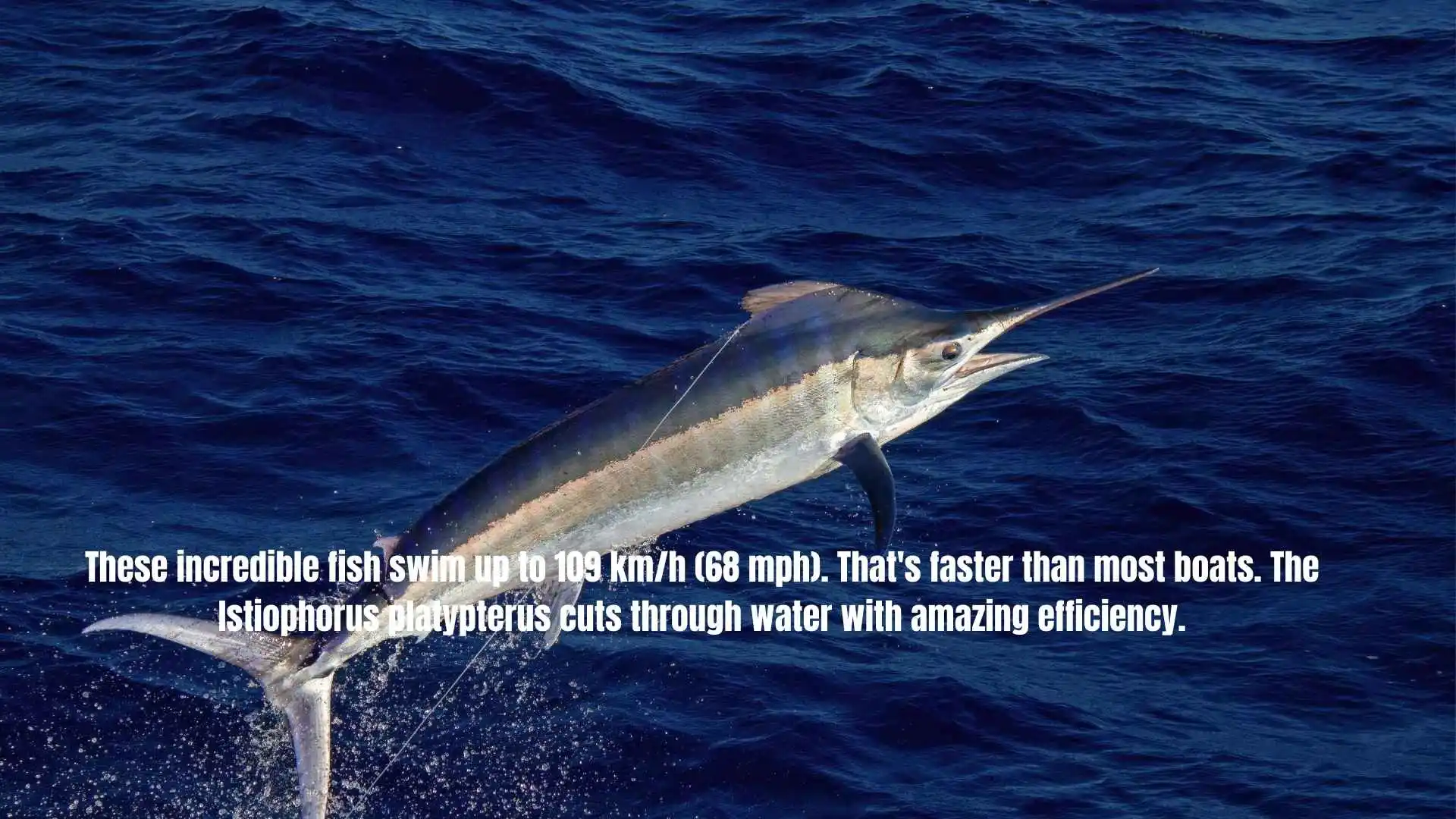
The sailfish is the fastest marine animal in the world.
These incredible fish swim up to 109 km/h (68 mph). That’s faster than most boats. The Istiophorus platypterus cuts through water with amazing efficiency.
Sailfish are named for their distinctive dorsal fin. This fin is much taller than their bodies. It looks like a ship’s sail. They also have an elongated bill similar to a swordfish. This helps them slice through water.
These pelagic species can grow to 304 centimeters (around 10 feet) long. They live in warmer oceans around the world. You’ll find them in tropical and subtropical waters.
Sailfish use their swimming speed for hunting prey. They eat large bony fish, crustaceans, and squid. Speed also helps them escape ocean predators like orcas and open ocean sharks.
But sailfish are in trouble. The population is decreasing. The IUCN Red List classifies them as vulnerable species. Overfishing threatens them. Many get caught accidentally as bycatch.
Swordfish – The Close Second
The swordfish isn’t far behind the sailfish.
These powerful fish swim at 97 km/h (60 mph). The Xiphias gladius is famous for its giant sword-like nose. This elongated bill cuts through water and reduces drag.
Swordfish live in tropical and temperate parts of the Atlantic, Pacific, and Indian Oceans. They’re pelagic species that prefer deep water.
These fish are slightly lighter and longer than sailfish. Swordfish weigh 22.67 to 90.71 kilograms (50 to 200 pounds) on average. They measure 455 centimeters (14.75 feet) long. Meanwhile, sailfish weigh up to 100 kilograms (220 pounds) and measure up to 300 centimeters (10 feet).
Swordfish use their speed to catch food and avoid predators like orcas. Their swimming speed is impressive. But their population is decreasing.
The IUCN lists swordfish as near threatened. Overfishing is the main problem. Fishing regulations limit the size of swordfish that can be caught. This protects juveniles. But many young fish still die on pelagic longline gear before they can be returned to the ocean. Driftnet fishing also kills many juvenile swordfish.
Surprising Speedsters: Unexpected Fast Animals
Mexican Free-Tailed Bat – The Fastest Mammal in Flight
Here’s a surprise. A tiny bat can fly faster than a cheetah can run.
The Mexican free-tailed bat averages 96.5 km/h (60 mph) in flight. But the Tadarida brasiliensis can reach nearly 160 km/h (100 mph) in short bursts. That makes it the fastest mammal in the air or on land.
These small creatures weigh only about 12 grams (0.42 ounces). But they’re incredibly fast fliers. They live in the United States, Mexico, Brazil, Colombia, and Argentina.
Mexican free-tailed bats use their speed to catch insects. They also need it to avoid predators. Speed helps during long-distance travel too.
The population is stable. The IUCN classifies them as least concern.
Pigeon – The Urban Speed Surprise
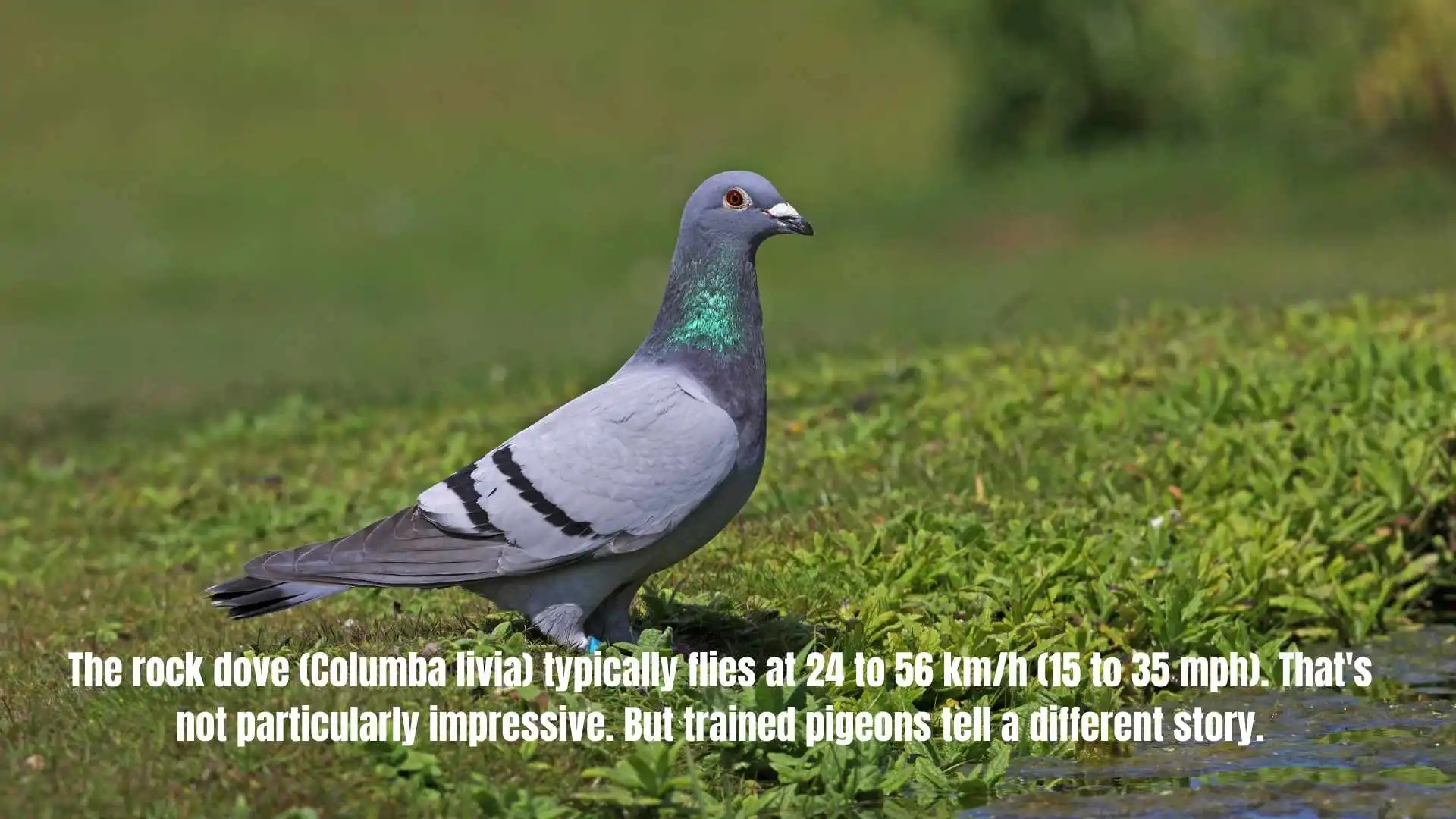
Don’t underestimate the common pigeon.
The rock dove (Columba livia) typically flies at 24 to 56 km/h (15 to 35 mph). That’s not particularly impressive. But trained pigeons tell a different story.
Domesticated pigeons can reach speeds up to 156 km/h (97 mph) in short bursts. That’s faster than many birds of prey. Their speed and navigation abilities made them valuable messengers throughout history.
Pigeons adapted to urban environments worldwide. Thanks to human activity, they spread across the globe. About 260,000,000 pigeons exist today. The IUCN lists them as least concern.
Speed Comparisons: How the Fastest Animals Stack Up
Air vs. Land vs. Sea: Breaking Down the Rankings
Different environments create different speed champions.
The fastest animals on Earth are all birds. The top five are peregrine falcon, golden eagle, white-throated needletail, Eurasian hobby, and gyrfalcon. All are flying animals.
The fastest land animal is the cheetah at 120 km/h (75 mph). No land animal comes close to matching the speeds of diving birds.
The fastest marine animal is the sailfish at 109 km/h (68 mph). That’s fast, but still slower than the cheetah.
Why do birds dominate? Physics plays a big role. Air offers less resistance than water. Gravity helps birds accelerate during dives. The combination creates perfect conditions for extreme speed.
Water is denser than air. This creates more resistance. Fish can’t match the speeds of birds in air. But they’re still incredibly fast considering the environment.
Land creates the most challenges. Friction with the ground slows animals down. Legs must physically push against the earth with each stride. This limits maximum speed.
Fastest Animals by Category
Here’s how the champions break down:
Fastest overall: Peregrine falcon at 320+ km/h (200+ mph)
Fastest land mammal: Cheetah at 120 km/h (75 mph)
Fastest marine animal: Sailfish at 109 km/h (68 mph)
Fastest in level flight: White-throated needletail at 168 km/h (105 mph)
Fastest bat: Mexican free-tailed bat at 160 km/h (100 mph) in bursts
Fastest domesticated animal: American quarter horse at 88 km/h (55 mph)
Fastest flightless bird: Ostrich at 70 km/h (43 mph)
Each category has its champion. Each champion evolved perfect adaptations for its environment.
Conservation Challenges Facing the World’s Fastest Animals
Threats to Speed Champions
Speed alone can’t save animals from modern threats.
Habitat loss is destroying the homes of the fastest animals on Earth. Savannahs and grasslands in Africa are disappearing. Development replaces wild spaces with farms and cities. Animals lose the room they need to hunt, migrate, and raise young.
Climate change affects animals worldwide. Rising temperatures change migration patterns. Weather becomes unpredictable. Food sources shift or disappear. Arctic animals like gyrfalcons face especially severe impacts.
Human-wildlife conflict kills thousands of animals yearly. Farmers shoot cheetahs to protect livestock. Birds fly into buildings, windows, and power lines. Vehicles strike animals crossing roads.
Overfishing depletes ocean populations. Sailfish and swordfish get caught in fishing gear. Many die as bycatch before they can be released. Juvenile fish die on longlines and in driftnets.
Illegal wildlife trade threatens many species. Cheetah cubs are stolen from the wild. They’re sold as exotic pets. Most die during transport or in captivity. The trade pushes cheetahs closer to extinction.
Poisoning harms birds of prey and other animals. Lead bullets kill prey. When raptors eat poisoned animals, they die too. Rat poison spreads through ecosystems. It kills birds, mammals, and reptiles.
Many endangered species and vulnerable species appear on this list. Sailfish are vulnerable. Cheetahs are vulnerable. Two albatross species are critically endangered. Seven more are endangered.
Success Stories in Wildlife Protection
But there’s hope. Conservation works when we commit to it.
The peregrine falcon recovery proves this. In the 1970s, these birds nearly went extinct in the United States. DDT poisoning devastated populations. The government listed them as endangered species. They banned DDT. Scientists started breeding programs.
The recovery was remarkable. Peregrine falcon numbers increased steadily. By 1999, they were removed from the endangered list. Today, they’re classified as least concern. It’s one of conservation’s greatest success stories.
Protected species legislation helps many animals. The Migratory Bird Treaty Act protects migratory birds in the United States. CITES Appendix I gives the strongest protection from international trade. CITES Appendix II regulates trade to prevent overexploitation.
The IUCN Red List tracks species status worldwide. It helps scientists identify which animals need help most. This information guides conservation priorities.
How IFAW and Other Organizations Help
IFAW works to protect animals around the world.
Their Beijing Raptor Rescue Center rescues injured birds of prey. The center treats peregrine falcons, golden eagles, and other raptors. Many birds get hurt flying into human infrastructure. Lead poisoning and rat poison harm others. The center provides animal rescue and rehabilitation.
IFAW’s Countering Cheetah Trafficking program fights the illegal wildlife trade. They work in the Horn of Africa and Arabian Peninsula. They rescue trafficked cheetah cubs. They train law enforcement. They raise awareness about the crisis.
Wildlife conservation organizations do critical work. They protect habitats. They rescue injured animals. They fight poaching and trafficking. They conduct research. They educate communities. They advocate for better laws.
But they need support to continue this work. IFAW and similar groups rely on donations and volunteers. Every contribution helps protect the fastest animals on Earth.
Fascinating Facts About the Fastest Animals on Earth
The fastest animals on Earth have amazing abilities.
A peregrine falcon diving at over 320 km/h experiences forces similar to a fighter pilot. Special adaptations prevent brain damage and eye problems. Baffles in their nostrils slow incoming air so they can breathe during dives.
Cheetahs accelerate faster than most sports cars. They reach 96 km/h (60 mph) in three seconds. Their acceleration rate is mind-blowing.
Sailfish can change color. When excited or hunting, they light up with brilliant blues and silvers. This may help coordinate attacks when they hunt in groups.
Anna’s hummingbirds perform incredible courtship displays. Males climb high in the air. Then they dive toward females at 96 km/h (60 mph). They pull up at the last second, creating a loud chirping sound with their tail feathers.
Mexican free-tailed bats can fly higher than 10,000 feet. They’ve been detected on weather radar. Millions emerge from caves at once, creating spectacular displays.
Pronghorns have the largest eyes of any land mammal relative to body size. This helps them spot predators from miles away across open plains.
Albatrosses can fly for hours without flapping their wings once. They use wind currents and dynamic soaring techniques. Some travel over 10,000 miles during a single foraging trip.
Evolution created these incredible speed adaptations over millions of years. Each animal is perfectly suited to its environment and lifestyle.
How You Can Help Protect Earth’s Fastest Animals
Take Action for Wildlife Conservation
You can make a difference for the fastest animals on Earth.
Support wildlife conservation organizations like IFAW. Donations fund rescue centers, anti-trafficking operations, habitat protection, and research. Every dollar helps.
Report illegal wildlife trade if you see it. Contact local authorities or organizations like IFAW. Don’t buy exotic animals as pets. Don’t support businesses that sell wild animals.
Reduce your carbon footprint to fight climate change. Use less energy. Drive less. Support renewable energy. Climate change threatens animals worldwide, especially those in sensitive environments like the Arctic Circle.
Advocate for protected habitats. Contact elected officials. Support policies that protect wild spaces. Habitat loss is a major threat. We need to preserve savannahs, grasslands, forests, and wetlands.
Educate others about endangered species and vulnerable species. Share information. Talk to friends and family. Awareness leads to action.
Make sustainable fishing choices. Overfishing threatens sailfish, swordfish, and other marine animals. Choose sustainably caught seafood. Support fishing regulations that protect juvenile fish.
Get Involved Locally
Local action matters too.
Volunteer with wildlife organizations in your area. Many groups need help with animal rescue, habitat restoration, and education programs.
Participate in citizen science projects. Help scientists track animal populations and migration patterns. Your observations contribute to real research.
Make your home and yard wildlife-friendly. Prevent bird strikes by marking windows. Avoid using rat poison, which harms birds of prey. Plant native species that support local wildlife.
Support legislation that protects animals. Vote for candidates who prioritize conservation. Contact representatives about wildlife issues.
conservation groups. Attend meetings. Participate in cleanup events. Work on habitat restoration projects.
Every action helps. Together, we can protect the fastest animals on Earth for future generations.
Conclusion
The fastest animals on Earth are truly remarkable. From the peregrine falcon diving at over 320 km/h to the cheetah sprinting across African plains, these creatures showcase nature’s incredible diversity.
Speed evolved for survival. It helps animals hunt. It helps them escape danger. It enables migration across vast distances. Each species developed unique speed adaptations perfectly suited to its environment.
We’ve explored birds of prey that dive like missiles. We’ve met the fastest land animal and fastest marine animal. We’ve discovered surprising speedsters like the Mexican free-tailed bat and trained pigeons. Each has its own story of adaptation and survival.
But speed alone can’t guarantee survival in today’s world. Human activity threatens many of these incredible creatures. Habitat loss, climate change, overfishing, and illegal wildlife trade push species toward extinction.
The good news? Conservation works. The peregrine falcon recovery proves it. When we protect habitats, ban harmful chemicals, and enforce strong laws, animals can recover.
Organizations like IFAW work tirelessly to protect wildlife worldwide. They rescue injured animals. They fight trafficking. They preserve critical habitats. They give animals a fighting chance.
But they can’t do it alone. They need your help. Support conservation efforts. Make sustainable choices. Spread awareness. Take action in your community.